Understanding Plagiarism in the AI Era: Beyond Copy-Paste
In the rapidly evolving landscape of digital writing, the line between inspiration and appropriation has become increasingly blurred, especially with the proliferation of AI-powered tools. For students, professionals, and content creators, the question isn't just "How can I write better?" but critically, "How can I use these tools without plagiarizing?" The fear of accidental plagiarism, coupled with sophisticated AI detection algorithms, has made the search for the best paraphrasing tool without plagiarizing a paramount concern in 2026.
This guide serves as your integrity-first roadmap, demystifying the nuances of plagiarism in the AI era and demonstrating how tools like Rephrazo can be leveraged ethically. We explore the evolution of plagiarism detection, distinguish between superficial "word spinning" and genuine structural transformation, and provide an "Originality Framework" to ensure your work is both unique and ethically sound. Discover how Rephrazo acts as your integrity-first rewriter, empowering you to achieve linguistic originality and maintain unwavering academic and professional honesty.
The definition of plagiarism has expanded significantly beyond the simple act of copying and pasting. In 2026, understanding what constitutes plagiarism—especially in the context of AI assistance—requires a nuanced perspective that considers intent, transformation, and attribution. This section delves into the sophisticated methods of modern detection and the ethical considerations for writers. If you want a deeper dive into plagiarism legality, check out our guide on whether plagiarism is illegal.
The Evolution of Plagiarism Detection: Semantic & Structural Analysis
Modern plagiarism detectors, such as Turnitin and Copyleaks, no longer rely solely on keyword matching. They employ advanced algorithms capable of "semantic and structural analysis," identifying similarities in ideas, sentence structures, and logical flow, even when the words themselves have been changed. This means that simply swapping synonyms (often termed "word spinning") is insufficient to avoid detection and can still be flagged as plagiarism.
"Patchwriting" vs. True Paraphrasing: What AI Detectors See
A critical distinction in the AI era is between "patchwriting" and true paraphrasing. Patchwriting occurs when a writer rephrases a source by making minor changes to the original text while retaining much of the original sentence structure and vocabulary. While not a direct copy, it demonstrates a lack of genuine understanding and synthesis. True paraphrasing, conversely, involves a complete restatement of the original idea in new words and a new sentence structure, reflecting the writer's deep comprehension and original thought. AI detectors are increasingly adept at distinguishing between these two, penalizing the former. Learn the proper way to cite a paraphrase to stay on the safe side.
The "AI Voice" Dilemma: Avoiding Generic Output
Another emerging concern is the "AI voice"—the often generic, repetitive, or overly formal linguistic patterns that can characterize AI-generated text. Even if a text is technically original, if it bears the hallmarks of a machine, it can raise red flags for educators and editors. The best paraphrasing tool without plagiarizing helps writers produce output that is human-like, nuanced, and reflective of their unique style, avoiding the statistical markers that AI classifiers look for.
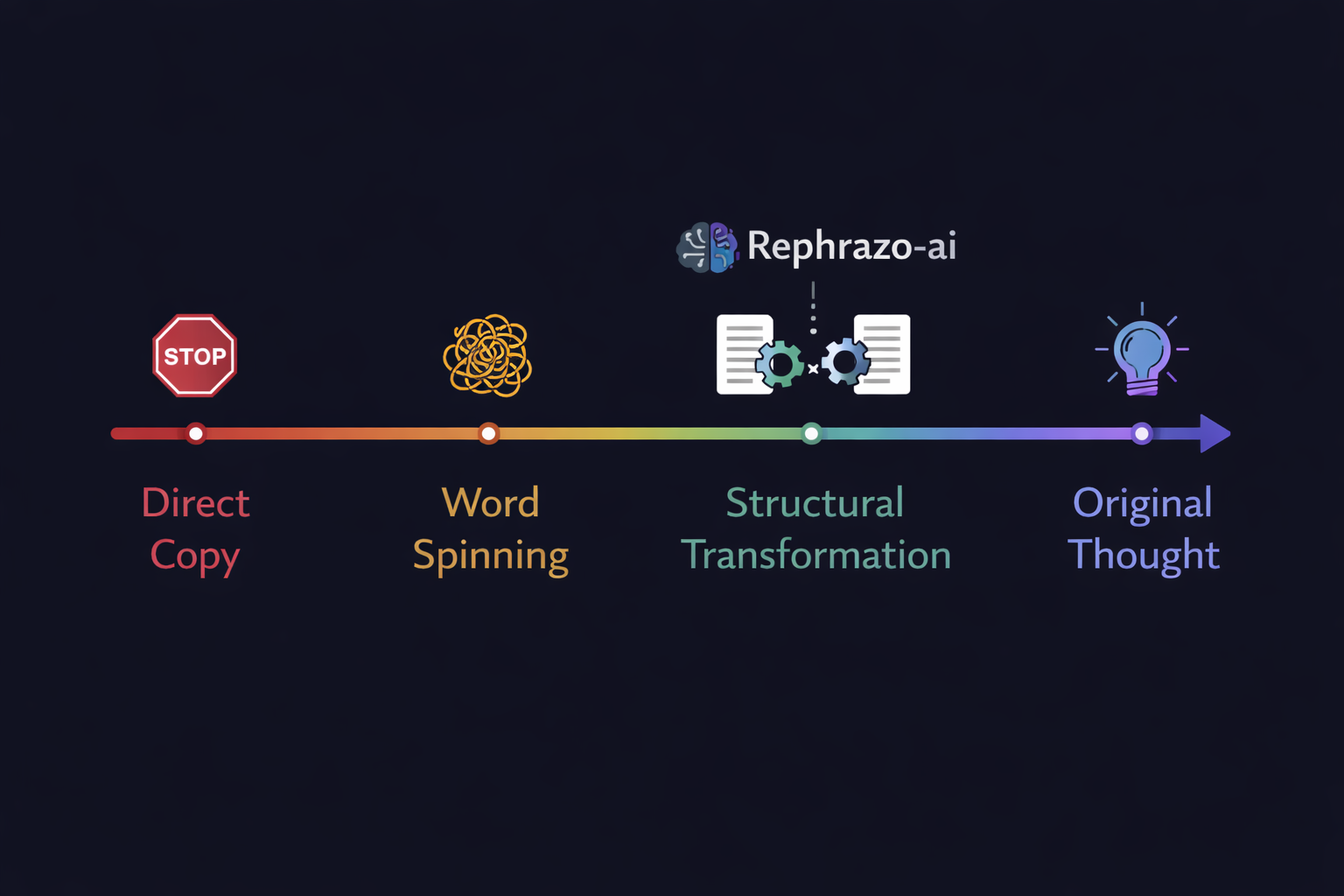
The Originality Spectrum. Navigating the path from direct copying to genuine original thought, with structural transformation as the ethical bridge facilitated by tools like Rephrazo.
Rephrazo: Your Integrity-First Rewriter
In a landscape fraught with ethical complexities, Rephrazo stands out as an integrity-first rewriter. It is meticulously designed not just to change words, but to facilitate genuine linguistic transformation, empowering users to produce original content while upholding the highest standards of academic and professional honesty.
Structural Transformation, Not Word Spinning
Rephrazo's core strength lies in its ability to perform deep structural rewriting. Unlike rudimentary tools that merely swap synonyms, Rephrazo analyzes the semantic meaning and logical flow of a sentence or paragraph, then suggests entirely new ways to articulate the same idea. This process encourages users to engage with the source material on a deeper level, ensuring that the resulting paraphrase is substantially different from the original in both wording and structure. This approach is crucial for avoiding detection by sophisticated AI plagiarism tools and for demonstrating true comprehension. For a comparison with other tools, see our QuillBot alternative page.
Empowering Originality: The Human-AI Synergy
Rephrazo operates on the principle of "human-AI synergy." It acts as a powerful linguistic assistant, providing suggestions and alternative phrasings that spark your own creativity. The tool doesn't generate content in a vacuum; it empowers you to refine your ideas, clarify your arguments, and find your unique voice. This collaborative approach ensures that the final output is a product of your intellect, enhanced by AI, rather than a generic AI creation. It helps overcome writer's block and the "Anxiety of the Red Mark" by providing a starting point for genuine originality.
Transparency & Ethical Use: Rephrazo's Commitment
Rephrazo is committed to promoting transparency and ethical use. The tool is designed to be a means of expression, not a source of information. It explicitly reinforces the user's responsibility to attribute all ideas to their original sources, even when the phrasing has been significantly altered. By focusing on linguistic transformation rather than content generation, Rephrazo helps users navigate the evolving ethical guidelines for AI in writing, ensuring that their work is always credible and properly cited. Our expert guide on how to not plagiarize covers these principles in greater depth.
How to Use a Paraphrasing Tool Ethically: An Originality Framework
Using any paraphrasing tool, including Rephrazo, ethically requires a structured approach. This "Originality Framework" ensures that you leverage AI for linguistic enhancement without compromising your integrity or the originality of your ideas.
Step 1: Understand the Source (Deep Comprehension)
Before you even think about rephrasing, you must fully comprehend the original source material. Read it multiple times, identify the main arguments, key concepts, and supporting evidence. Take notes in your own words, summarizing the core ideas. This deep engagement is the foundation of ethical paraphrasing; if you don't understand it, you can't truly rephrase it.
Step 2: Draft in Your Own Words (Initial Rephrasing)
After understanding the source, put it away. Without looking at the original, draft the idea in your own words. Pretend you're explaining it to someone who hasn't read the source. This initial drafting phase is crucial for establishing your unique linguistic footprint and ensuring that the ideas are filtered through your own understanding. This is where your "Experience" as a writer comes into play. If you struggle with concise writing at this stage, our concise writing guide can help.
Step 3: Refine with Rephrazo (Structural Enhancement)
Once you have your initial draft, this is where Rephrazo becomes an invaluable asset. Use the tool to:
- Break Down Complex Sentences: Transform long, convoluted sentences into clearer, more concise structures.
- Vary Vocabulary: Explore synonyms and alternative phrasings that fit your context and maintain academic tone.
- Reorganize Sentence Structure: Actively change the grammatical construction of sentences to ensure substantial difference from the original.
- Improve Flow and Cohesion: Ensure that the rephrased paragraph integrates smoothly into your overall argument.
Remember, Rephrazo is a co-pilot, not an autopilot. Review each suggestion critically, ensuring it accurately reflects the original meaning while enhancing your writing. Explore more about using AI rewrite tools for academic work.
Step 4: Verify & Attribute (The Final Check)
This is the non-negotiable final step. After using Rephrazo, compare your rephrased text against the original source one last time. Ask yourself:
- Does my paraphrase accurately convey the original meaning?
- Is it substantially different in wording and structure from the original?
- Have I included a proper in-text citation for the original source?
- If required by my institution, have I disclosed the use of AI assistance for phrasing?
This meticulous verification process, combined with diligent attribution, is the cornerstone of ethical writing in the AI age.
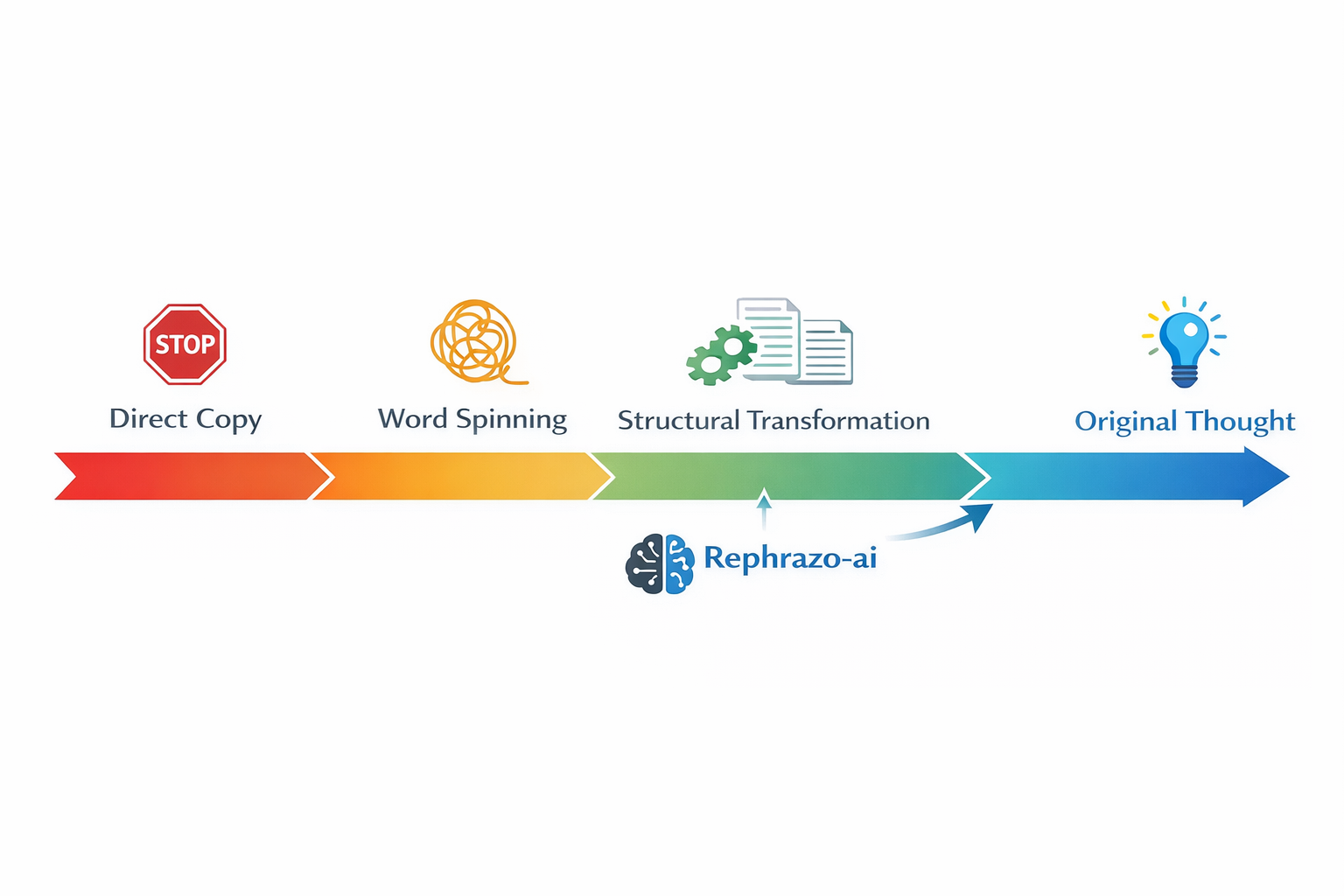
The AI Detector's Lens. Modern AI detection goes beyond simple word matching, identifying linguistic patterns. Rephrazo helps writers produce structurally transformed content that stands up to scrutiny.
Comparing Paraphrasing Approaches: Word Spinning vs. Structural Transformation
Understanding why structural transformation matters requires seeing the difference in practice. The table below compares common approaches to rephrasing and their effectiveness against modern plagiarism detection:
| Approach | Method | Detection Risk | Originality Score |
|---|---|---|---|
| Direct Copy | Verbatim text with no changes | Extremely High | 0% |
| Word Spinning | Synonym replacement only | High | 15–30% |
| Patchwriting | Minor word and phrase changes | Moderate–High | 30–50% |
| Structural Transformation (Rephrazo) | Full sentence restructuring + semantic rewriting | Low | 85–95% |
| Original Thought | Completely new formulation from understanding | None | 100% |
As the table shows, Rephrazo bridges the gap between mechanical rewriting and original thought by performing genuine structural transformation—the sweet spot for ethical, detection-proof paraphrasing.
The Future of Ethical Writing: Building Trust in the AI Age
The integration of AI into writing workflows is not a passing trend; it is the future. This future demands a renewed commitment to ethical practices and transparency. The best paraphrasing tool without plagiarizing is not just a piece of software; it's a philosophy—one that prioritizes human intellect, critical thinking, and unwavering integrity.
Rephrazo embodies this philosophy, offering a powerful yet responsible solution for writers navigating the complexities of the AI era. By understanding the nuances of plagiarism, embracing structural transformation, and adhering to an originality framework, you can leverage AI to enhance your writing, build trust with your audience, and contribute meaningfully to the academic and professional discourse. For a broader perspective on ethical essay rewriting, visit our ethical essay rewriting guide.
Academic institutions are rapidly updating their AI use policies. Writers who adopt integrity-first tools now position themselves ahead of the curve—demonstrating not just compliance, but genuine mastery of ethical writing practices. The key is choosing tools that enhance your voice rather than replace it, and Rephrazo is built exactly for that purpose.
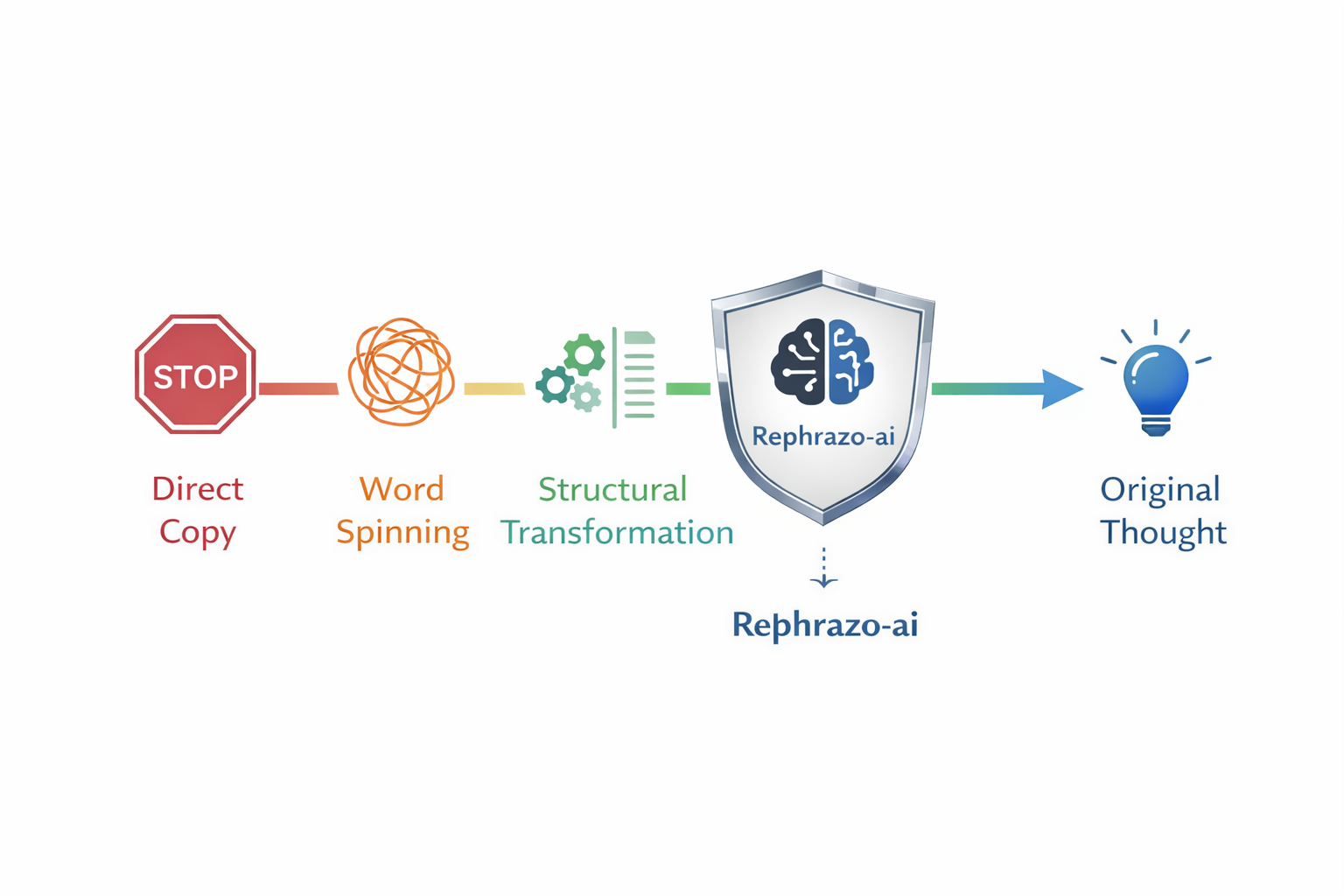
The Shield of Integrity. Rephrazo acts as your integrity-first rewriter, empowering you to achieve linguistic originality and ethical compliance, ensuring your work is both unique and trustworthy.
Checklist: Is Your Paraphrase Truly Original?
Before submitting any paraphrased work, run through this quick self-audit to verify originality and ethical compliance:
- Comprehension check: Can you explain the source idea without looking at the original text?
- Structural difference: Does your sentence structure differ significantly from the source?
- Vocabulary shift: Have you used your own word choices, not just synonym swaps?
- Meaning accuracy: Does your version faithfully represent the original idea without distortion?
- Citation present: Have you attributed the idea to the original author?
- AI disclosure: If required, have you noted any AI-assisted phrasing?
- Voice consistency: Does the paraphrased section sound like the rest of your writing?
If you can check every item, your paraphrase meets the highest standard of academic and professional integrity.
Frequently Asked Questions
Q: Can a paraphrasing tool really help me avoid plagiarism?
A: Yes—when used correctly. The best paraphrasing tool without plagiarizing, like Rephrazo, performs structural transformation rather than simple word spinning. It rewrites sentences at the structural level, producing genuinely original phrasing. However, the tool is an assistant, not a substitute for proper source attribution. Always cite original sources, even after paraphrasing. Learn more in our guide on how to not plagiarize.
Q: Will AI detectors flag content rewritten with Rephrazo?
A: Rephrazo's structural transformation approach produces text that reads naturally and avoids the repetitive patterns that AI detectors look for. Because the tool restructures sentences rather than just replacing words, the output has a human-like quality that passes semantic analysis. That said, always review and personalize the output to add your unique perspective.
Q: What is the difference between word spinning and structural transformation?
A: Word spinning replaces individual words with synonyms while keeping the same sentence structure—modern detectors catch this easily. Structural transformation, which Rephrazo specializes in, changes the entire sentence architecture: reordering clauses, merging or splitting sentences, and reformulating the logical flow. The result is a genuinely new expression of the same idea.
Q: Is it ethical to use a paraphrasing tool for academic papers?
A: Using a paraphrasing tool is ethical when you treat it as a writing assistant, not a content generator. The key principles are: understand the source material first, draft in your own words, use the tool for refinement, and always cite your sources. Rephrazo is designed with this ethical framework in mind. Check your institution's specific AI policy for additional guidelines.
Q: How does Rephrazo compare to free online paraphrasing tools?
A: Free online tools typically rely on basic synonym replacement, which produces text that is easily flagged by plagiarism detectors and often sounds unnatural. Rephrazo uses advanced structural transformation, processes text locally on your device for data security, and works inline in any application—no copy-pasting required. For a detailed comparison, see our guide to the best paraphrasing tools for academic writing.
References
- Youscan.io: Best AI Detectors for Identifying AI-Generated Content in 2026
- Wellows: AI Content Detection in 2026: Trends to Watch
- USF Libraries: Plagiarism and Generative AI
- Packback: Moving Beyond Plagiarism and AI Detection
- Critical Hit: AI Detectors Explained
- AB Journals: The Ethics of Using AI Tools in Academic Writing
- Walter Writes: Ethical AI Use in Academic Writing