Introduction: The Academic Writing Challenge
The academic journey is a demanding one, requiring not only rigorous research and critical thinking but also the ability to articulate complex ideas with clarity and precision. For many students and researchers, transforming raw thoughts and initial drafts into polished, submission-ready work can be a significant challenge. In 2026, Artificial Intelligence (AI) rewrite tools have emerged as powerful assistants, offering unprecedented opportunities to refine prose, enhance readability, and strengthen arguments. However, their ethical use within academic contexts remains a critical discussion.
This comprehensive guide delves into the nuanced world of AI rewrite tools, specifically focusing on their application in ethical academic revision. We will explore the crucial distinction between merely paraphrasing and truly rewriting, examine how to navigate evolving university AI policies, and demonstrate how tools like Rephrazo can serve as an invaluable Revision Co-pilot. Our aim is to empower you to leverage AI effectively, ensuring your work maintains its originality, integrity, and academic rigor. By understanding the capabilities and ethical boundaries of these tools, you can transform your writing process, moving from struggle to mastery with confidence and clarity.
Beyond Word Swapping: The Technical Distinction Between Rewriting and Paraphrasing
In academic writing, the terms "rewriting" and "paraphrasing" are often used interchangeably, yet they represent distinct processes with different objectives and implications for academic integrity. Understanding this technical distinction is fundamental to ethically employing an AI rewrite tool and ensuring your work reflects genuine Expertise.
The Nuances of Paraphrasing: Integrating Sources Ethically
Paraphrasing involves restating someone else's ideas or information from a source in your own words, while maintaining the original meaning. It is a critical skill for integrating evidence and supporting arguments in academic papers without directly quoting. Key characteristics include:
- Primary Goal: To integrate external information into your text smoothly and ethically, avoiding plagiarism by properly attributing the source.
- Source Material: Always derived from external sources (e.g., books, journal articles, research papers).
- Focus of Change: Primarily lexical (changing words and phrases) and syntactic (altering sentence structure) while preserving the original narrative and meaning.
- Risk: High risk of accidental plagiarism if the rephrasing is too close to the original text or if the source is not properly cited.
AI tools can assist in generating paraphrases, but human oversight is paramount to ensure the meaning is accurately conveyed and proper citation is applied.
The Power of Rewriting: Clarifying Your Own Ideas and Improving Flow
Rewriting, in the context of an AI rewrite tool, refers to the process of transforming your *own* original text to improve its clarity, conciseness, flow, and overall impact. It's about enhancing your existing ideas, not rephrasing someone else's. This process is vital for refining your arguments and ensuring your voice shines through. Key characteristics include:
- Primary Goal: To clarify, refine, and improve the structure and style of your own original text, making your arguments more compelling.
- Source Material: Your own drafts, ideas, and arguments.
- Focus of Change: Structural (sentence, paragraph, argument flow), stylistic (tone, word choice for impact), and clarity enhancements.
- Benefit: Helps overcome writer's block, improves readability, and ensures your complex ideas are accessible to your audience.
An effective AI rewrite tool, like Rephrazo, focuses on this latter aspect, acting as a linguistic mirror to help you see and improve your own writing.
| Feature | Paraphrasing (Source Integration) | Rewriting (Self-Revision) |
|---|---|---|
| Primary Goal | To restate another author's ideas in your own words while maintaining meaning. | To clarify, refine, and improve the structure and flow of your own original text. |
| Source Material | External sources (books, articles, research papers). | Your own drafts, ideas, and arguments. |
| Focus of Change | Lexical (word choice), sentence structure, but preserving original meaning. | Structural (sentence, paragraph, argument flow), stylistic, clarity, conciseness. |
| Risk of Plagiarism | High if not properly cited or if too close to original phrasing. | Low, as it applies to your own work, but can lead to generic "AI voice" if overused. |
| AI Tool Role | Can assist in rephrasing sentences, but human oversight is critical for citation. | Can suggest structural improvements, tone adjustments, and clarity enhancements. |
The Integrity Threshold: Using AI as a Revision Co-pilot, Not a Replacement
The integration of AI into academic writing has raised important questions about academic integrity. Universities worldwide are rapidly developing policies to guide students on the ethical use of these powerful tools. The consensus emerging in 2026 is clear: AI should serve as a Revision Co-pilot, augmenting your capabilities and enhancing your work, rather than replacing your intellectual contribution. This approach emphasizes Trustworthiness and responsible scholarship.
Navigating 2026 University AI Policies: Transparency and Responsibility
Leading institutions like the University of Toronto, McGill University, and the University of Alberta have issued guidelines that stress transparency and responsibility. Key takeaways for students include:
- Disclosure: Always clarify your use of AI tools as per your institution's specific guidelines. If a course permits AI, understand how to acknowledge its role.
- Originality: The final work must reflect your own ideas, analysis, and voice. AI should not be used to generate content that you then present as entirely your own.
- Understanding: You must fully understand any text that AI helps you revise. The tool is there to clarify your thoughts, not to think for you.
- Ethical Use: AI should be used to enhance learning and writing skills, not to bypass the learning process or to commit academic misconduct.
An AI rewrite tool, when used ethically, becomes a powerful ally in meeting these standards, helping you refine your expression without compromising your integrity.
The Human-in-the-Loop: Maintaining Your Voice and Originality with AI
The most effective use of an AI rewrite tool involves a Human-in-the-Loop approach. This means you remain the primary author and decision-maker, with the AI offering suggestions and alternatives. Rephrazo is designed with this philosophy, ensuring that your unique voice and originality are preserved and amplified:
- Curated Suggestions: Rephrazo provides multiple rewriting options, allowing you to choose the one that best aligns with your intended meaning and style.
- Focus on Enhancement: The tool focuses on improving clarity, conciseness, and flow, rather than imposing a generic "AI voice."
- Iterative Revision: It supports an iterative revision process, where you can apply changes, review, and further refine, ensuring the final output is truly yours.
- Empowering Your Expertise: By handling the linguistic heavy lifting, Rephrazo frees you to concentrate on the higher-order thinking, research, and argumentation that define academic Expertise.
This collaborative model ensures that AI serves as a powerful assistant, helping you to articulate your ideas with greater precision and impact, while always maintaining your intellectual ownership.

Image 1: The Human-AI Collaboration. Ethical academic revision leverages AI as a co-pilot, where tools like Rephrazo enhance a student's critical thinking and writing, rather than replacing it.
Structural Transformation: How to Sharpen Your Thesis and Improve Cohesion
Beyond correcting grammatical errors, a truly effective AI rewrite tool assists in the deeper, more impactful process of Structural Transformation. This involves refining the architecture of your arguments, ensuring logical flow, and enhancing the overall cohesion of your academic work. Rephrazo excels in this area, helping you to elevate your writing from merely correct to truly compelling, demonstrating your academic Expertise.
From Passive to Active: Enhancing Impact and Clarity
One common challenge in academic writing is the overuse of the passive voice, which can make prose sound convoluted and less authoritative. An AI rewrite tool can identify passive constructions and suggest more direct, active alternatives, thereby:
- Increasing Clarity: Active voice makes it immediately clear who is performing the action, reducing ambiguity.
- Enhancing Impact: Active sentences are generally more direct and forceful, making your arguments more persuasive.
- Improving Conciseness: Often, active constructions are shorter and more economical, contributing to overall readability.
Rephrazo helps you make these strategic choices, transforming weak sentences into strong, assertive statements that bolster your arguments.
Building Bridges: Improving Sentence and Paragraph Cohesion
Cohesion refers to how well the parts of your writing connect to form a unified whole. A lack of cohesion can make your arguments seem disjointed and difficult to follow. An advanced AI rewrite tool can assist in:
- Transition Word Suggestions: Identifying opportunities to insert appropriate transition words and phrases (e.g., "however," "consequently," "furthermore") to create smoother logical bridges between ideas.
- Sentence Flow Improvement: Restructuring sentences to ensure a natural progression of thought, making your writing more fluid and engaging.
- Paragraph Unity: Highlighting sentences that might disrupt the main idea of a paragraph, allowing you to refine its focus.
By focusing on these structural elements, Rephrazo helps you build a robust and coherent argument, ensuring your readers can effortlessly follow your line of reasoning.
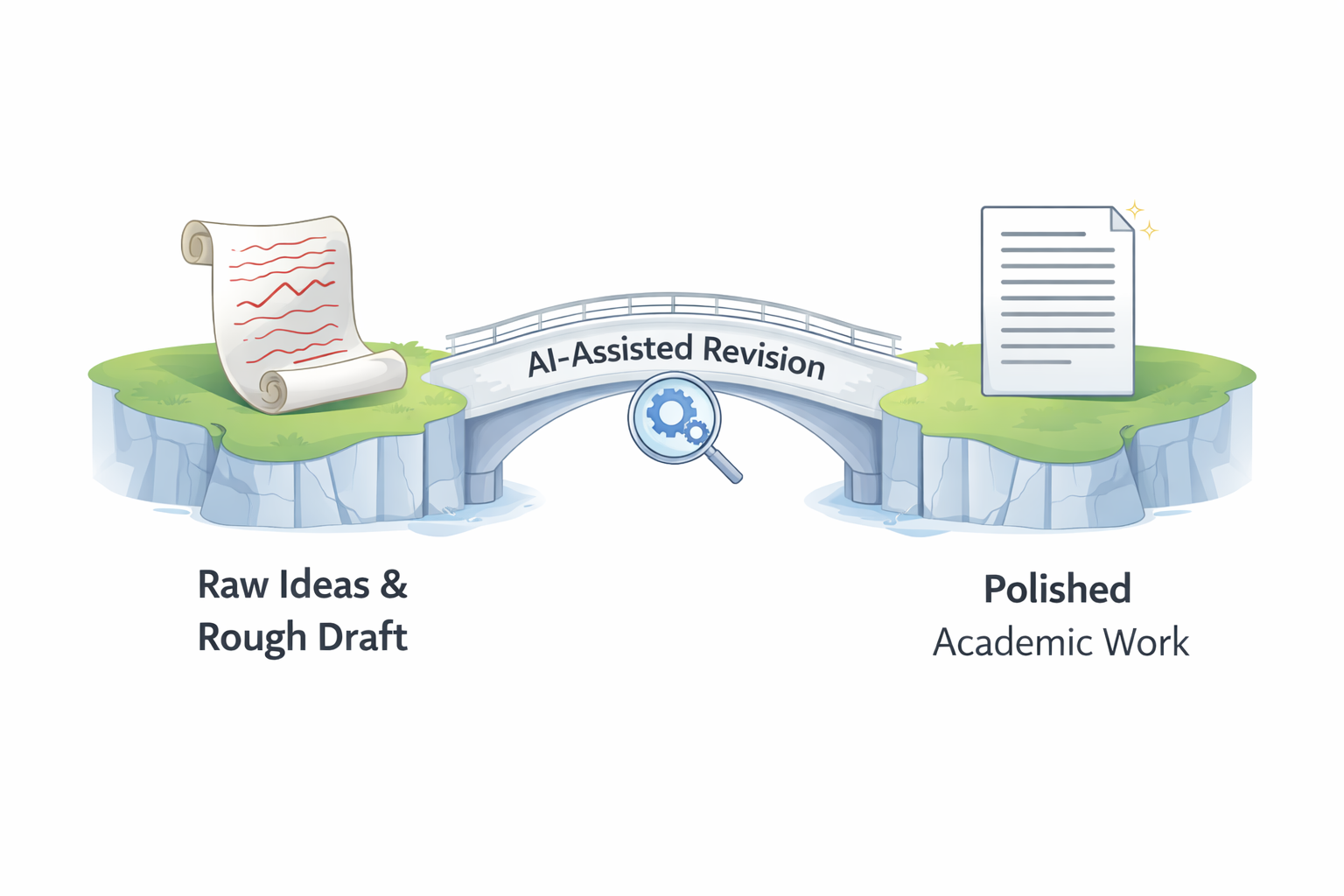
Image 2: The Academic Revision Bridge. AI rewrite tools like Rephrazo serve as a crucial bridge, transforming raw ideas and rough drafts into polished, submission-ready academic work.
How to Choose the Right AI Rewrite Tool for Academic Writing
Selecting the right AI rewrite tool for academic work requires careful consideration of several factors. Not all tools are created equal, and what works for general writing may not meet the specific needs of academic writing. Here's what to look for:
Key Features for Academic AI Rewrite Tools
When evaluating potential AI rewrite tools for academic use, consider these essential features:
- Academic Tone Preservation: The tool should maintain formal, scholarly language while improving clarity.
- Context Awareness: It should understand the academic context and provide suggestions that enhance rather than simplify complex ideas.
- Privacy and Security: For sensitive research, local processing ensures your work never leaves your device.
- Integration: Seamless integration with Word, LaTeX, or other academic writing environments reduces workflow disruption.
- Ethical Design: The tool should enhance your writing, not replace your thinking or generate content.
Why Rephrazo Stands Out for Academic Writing
Rephrazo is specifically designed to meet the unique needs of academic writers. Unlike general-purpose AI tools, Rephrazo focuses on refinement and enhancement, ensuring your original ideas and voice remain central. Its local processing architecture provides the privacy and security essential for sensitive research, while its inline functionality integrates seamlessly into your existing workflow. For more information on choosing the right tool, see our guide on AI rewriter tools and essay rewriting.
Rephrazo: Your Ethical Partner in Academic Excellence
In the dynamic academic environment of 2026, choosing the right AI rewrite tool is paramount. Rephrazo is engineered to be more than just a text transformer; it is designed as an ethical partner in your pursuit of academic excellence. Our focus is on empowering your Expertise and ensuring the Trustworthiness of your revised work, allowing you to concentrate on the intellectual heavy lifting.
Precision and Nuance: Rephrazo for Academic Rigor
Academic writing demands precision. Rephrazo understands this, offering features tailored to the unique needs of students and researchers:
- Context-Aware Rewriting: It analyzes the semantic context of your sentences to provide suggestions that maintain academic tone and meaning, avoiding generic or informal phrasing.
- Clarity Enhancement: For complex scientific or philosophical concepts, Rephrazo can suggest ways to simplify language without sacrificing accuracy, making your work more accessible.
- Conciseness for Impact: In fields where word limits are strict, the tool helps condense verbose passages into impactful, concise statements.
- Grammar and Style Refinement: Beyond basic corrections, it offers advanced suggestions for improving academic style, such as reducing nominalizations or strengthening logical connections.
This level of precision ensures that your revised work meets the rigorous standards of academic publication and submission.
Seamless Integration: Enhancing Your Workflow, Not Disrupting It
Academic life is busy, and workflow efficiency is key. Rephrazo is designed to integrate seamlessly into your existing writing process, minimizing disruption and maximizing your productivity:
- Inline Functionality: Work directly within your preferred writing applications (e.g., Microsoft Word, Google Docs, LaTeX editors) without constant copy-pasting.
- Hotkey-Driven Efficiency: Access powerful rewriting capabilities with simple keyboard shortcuts, keeping your hands on the keyboard and your mind on your research.
- Real-time Suggestions: Receive instant feedback and rewriting options as you type or highlight text, facilitating an agile revision process.
- Focus on Content: By automating the linguistic refinement, Rephrazo allows you to dedicate more time to the critical thinking, research, and analysis that are at the heart of academic success.
Rephrazo is not just a tool; it's a strategic partner that helps you navigate the complexities of academic writing with greater ease and confidence.
Frequently Asked Questions (FAQ)
Q: What is an AI rewrite tool, and how does it differ from a paraphrasing tool?
A: An AI rewrite tool refines and improves your own original text, focusing on clarity, flow, and structure. A paraphrasing tool restates someone else's ideas in different words. Rewriting enhances your own writing, while paraphrasing integrates external sources. Both have their place in academic writing, but understanding the distinction is crucial for ethical use.
Q: How does Rephrazo ensure my academic integrity?
A: Rephrazo is designed as a revision co-pilot, not a content generator. It helps you refine your own text for clarity and impact, ensuring your original ideas and voice remain central. We encourage users to always follow their institution's guidelines on AI tool disclosure and to use Rephrazo to enhance their understanding and writing skills, not to bypass the learning process.
Q: Can an AI rewrite tool help me avoid accidental plagiarism?
A: While Rephrazo primarily focuses on rewriting your own text, by improving clarity and offering diverse phrasing, it can indirectly help you articulate your ideas more distinctly, reducing the risk of unintentional "patchwriting" when integrating sources. However, proper citation and understanding of source material remain your responsibility. Learn more about plagiarism prevention.
Q: Is Rephrazo suitable for all types of academic writing?
A: Yes, Rephrazo is versatile and can assist with essays, research papers, theses, dissertations, and more. Its focus on structural and stylistic refinement is beneficial across various academic disciplines, helping you achieve a high level of linguistic precision and impact. Whether you're writing in the humanities, sciences, or social sciences, Rephrazo adapts to your needs.
Q: Does Rephrazo work with academic citation styles like APA, MLA, or Chicago?
A: Rephrazo focuses on improving the clarity, flow, and structure of your writing rather than formatting citations. However, by enhancing your prose, it helps ensure your citations are integrated smoothly into your text. For citation formatting, you should use dedicated citation management tools alongside Rephrazo.
Conclusion: Mastering Ethical Academic Revision
The academic writing process demands both intellectual rigor and linguistic precision. An AI rewrite tool, when used ethically and thoughtfully, can be a powerful ally in this journey. By understanding the distinction between rewriting and paraphrasing, navigating university AI policies, and choosing tools that enhance rather than replace your expertise, you can transform your writing process while maintaining academic integrity.
Rephrazo exemplifies this ethical approach, offering precision, privacy, and seamless integration that empowers you to refine your academic work with confidence. Whether you're working on essays, research papers, or dissertations, Rephrazo helps you articulate your ideas with clarity and impact, ensuring your voice and originality remain central.
Ready to elevate your academic writing? Download Rephrazo free and experience ethical AI-assisted revision that enhances your expertise without compromising your integrity. Discover how local processing, inline integration, and specialized refinement can transform your academic writing process. Explore more guides on essay rewriting, improving your writing, and grammar correction.