How to Rewrite My Essay Ethically: The Expert Guide to AI-Assisted Academic Revision
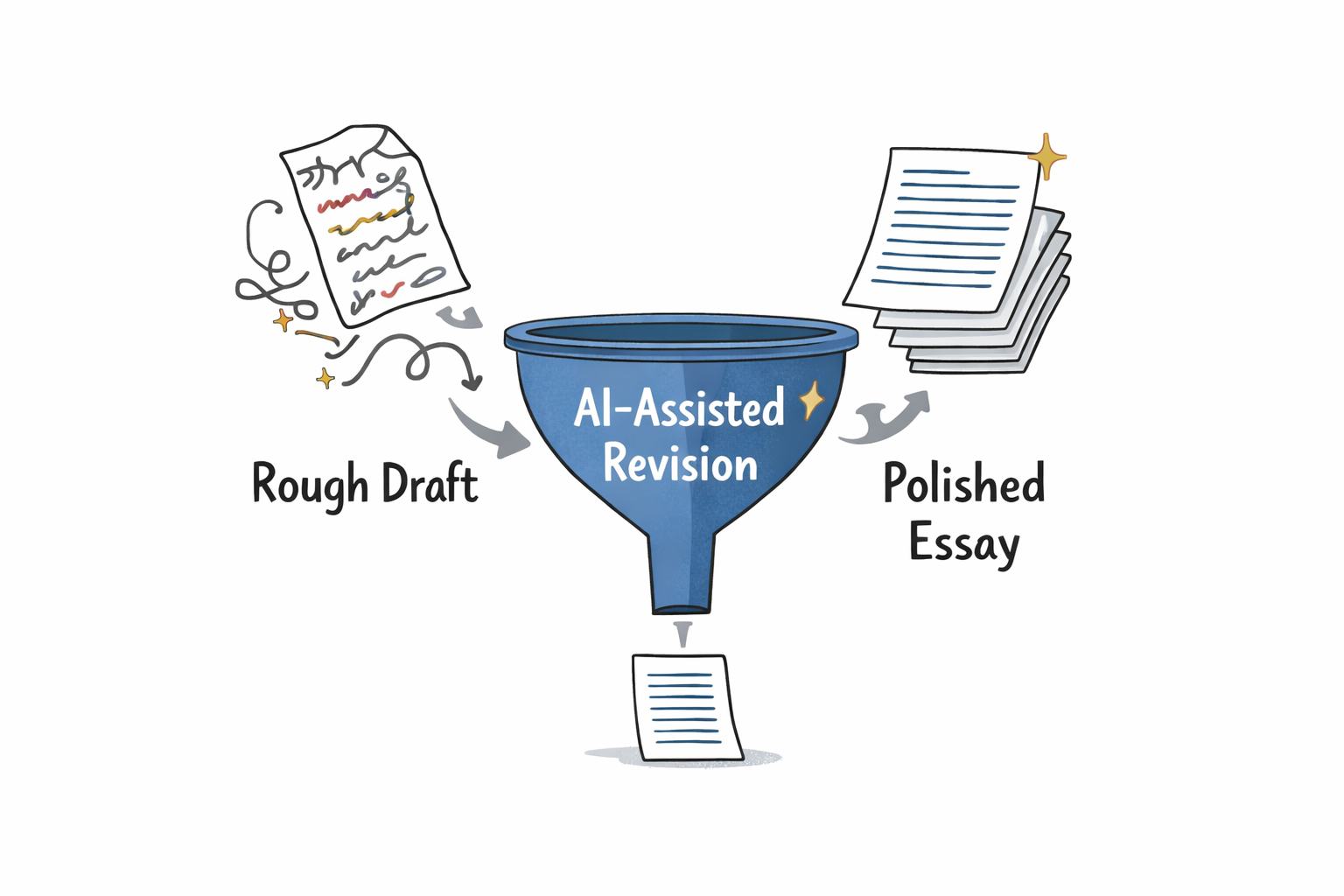
Using AI as a filter to transform a rough draft into a clear, authoritative final essay, while maintaining the writer's original ideas.
Introduction
The phrase "rewrite my essay" often signals a moment of deep frustration. You have invested hours into research and drafting, yet the final product feels flat, repetitive, or fails to capture the sophistication of your ideas. This is the "Revision Wall"—the point where you are too close to your own work to see its flaws, and manual revision becomes an exercise in futility. For students, this moment is critical: a poorly revised essay can significantly undermine excellent research.
In the age of AI, the question is no longer if you should use a tool to rewrite your essay, but how to use it responsibly and ethically. The Expertise and Trustworthiness pillars of E-E-A-T demand a clear framework. A modern AI tool, particularly one designed for seamless integration like Rephrazo, is not a shortcut to bypass learning; it is a powerful co-pilot that helps you overcome the mechanical hurdles of revision, allowing your original voice and argument to shine through. The key is understanding the difference between using AI to refine your existing work and using it to generate new, unoriginal content.
This guide provides an expert-led strategy for leveraging AI to overhaul your essay's style and structure, while strictly adhering to academic integrity. We will define the boundaries of ethical rewriting and demonstrate why a privacy-first approach is non-negotiable when handling sensitive academic drafts. Discover more about essay rewriting techniques and how to avoid plagiarism.
Defining Revision: Rewriting vs. Paraphrasing vs. Editing
To use an AI tool effectively, you must first understand the specific task you are asking it to perform. Many students use the terms "editing," "paraphrasing," and "rewriting" interchangeably, but they represent distinct levels of textual modification. Misunderstanding these differences is the first step toward misuse.
Paraphrasing: The Sentence-Level Fix
Paraphrasing is the act of restating a specific passage or sentence from a source text in your own words, primarily to avoid plagiarism while integrating evidence. It is a localized, sentence-by-sentence task. While crucial for citation, it does not address the overall flow or structure of your essay. A tool like Rephrazo, with its inline functionality, excels at this, providing instant, context-aware alternatives to source material.
Rewriting: The Structural and Stylistic Overhaul
Rewriting is a far more comprehensive process. It involves altering the style, tone, and structure of entire paragraphs or sections to improve clarity, strengthen arguments, or adjust the essay to meet new requirements (e.g., changing a formal essay into a policy brief). When you ask to "rewrite my essay," you are seeking this higher-level, structural intervention. The goal is to make the essay sound more professional, authoritative, and coherent, without changing the core intellectual contribution (your thesis and analysis).
The Expertise required here is knowing which parts of the essay need a structural overhaul. AI can suggest alternative organizational patterns or rephrase entire sections to improve logical transitions, but the writer must guide the process, ensuring the intellectual thread remains intact. The AI acts as a linguistic architect, suggesting blueprints for better flow.
| Modification Type | Scope | Primary Goal | Risk of Plagiarism (If Misused) |
|---|---|---|---|
| Editing | Word/Punctuation | Correct grammar, mechanics, and spelling. | Low. |
| Paraphrasing | Sentence/Passage | Rephrase source material to avoid plagiarism. | Moderate (if too close to source). |
| Rewriting | Paragraph/Section/Essay | Overhaul style, tone, and structure for clarity. | High (if the core idea is not the student's). |
The Hidden Cost of Manual Essay Revision
The traditional method of essay revision—printing it out, marking it up, and manually rewriting sections—is inefficient and often ineffective. This is where Experience comes into play. As practitioners of academic writing, we recognize two major obstacles that manual revision fails to overcome.
Cognitive Fatigue and the "Revision Blind Spot"
After spending days or weeks immersed in a topic, writers develop a "revision blind spot." Their brain automatically fills in the gaps, making it difficult to spot awkward phrasing, weak transitions, or logical leaps that are clear to them but opaque to a reader. Manual revision at this stage is often just shuffling the same flawed words around. Furthermore, the sheer cognitive load of holding the entire essay's structure in mind while simultaneously trying to rephrase a complex paragraph leads to burnout and diminishing returns.
Why AI is the Ideal Revision Partner (Not Replacement)
AI-assisted rewriting overcomes the revision blind spot by providing an objective, external perspective. It can instantly generate alternative phrasing that breaks the writer out of their linguistic rut. The speed of tools like Rephrazo is crucial here: instead of spending 20 minutes trying to manually fix a single awkward paragraph, the writer can generate three distinct, high-quality options in 20 seconds. This allows the writer to spend the remaining time on the most important task: critical evaluation.
The AI acts as a tireless, instant editor, handling the mechanical work of restructuring sentences and suggesting stylistic improvements. This partnership is the core of modern, efficient academic workflow. By offloading the linguistic heavy lifting, the writer can focus their energy on strengthening the argument, verifying sources, and ensuring the essay meets the highest standards of Authoritativeness.
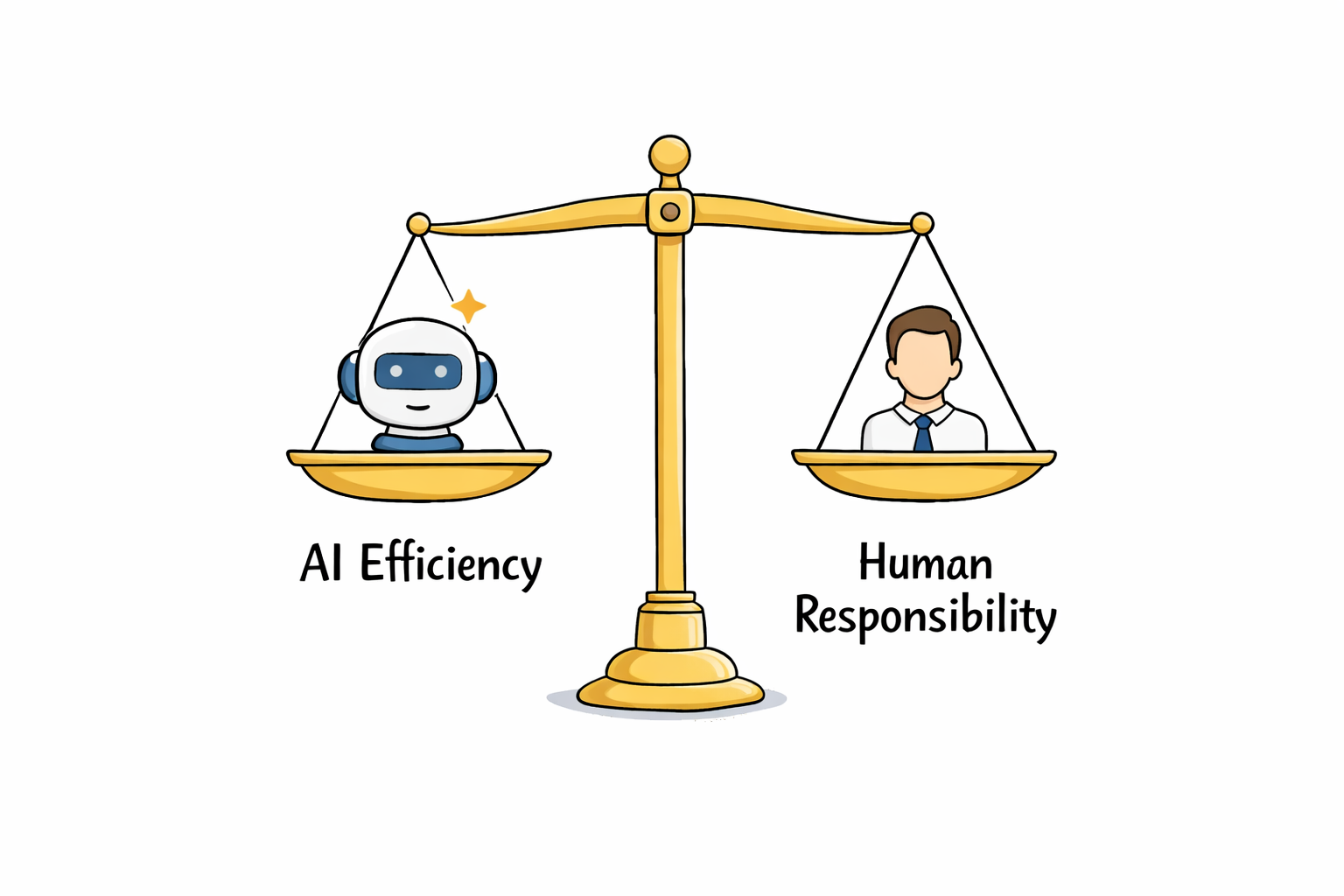
Ethical essay rewriting requires an equal measure of AI efficiency and human critical responsibility. The writer must always maintain control.
Academic Integrity and the Ethical Use of AI Rewriting Tools
The most pressing concern when using any tool to "rewrite my essay" is academic integrity. The Trustworthiness of your work depends entirely on how you integrate the tool into your process. Institutions are clear: submitting work that is not substantially your own is misconduct. The ethical use of AI rewriting tools is defined by two core principles.
The "Final Draft" Fallacy: Why You Must Own the Output
The fallacy is believing that because an AI tool generated a polished sentence, the work is complete. The reality is that the AI's output is merely a suggestion. If you use Rephrazo to rewrite a paragraph, you must treat that output as a draft that requires your full intellectual engagement. You must verify that the new phrasing accurately reflects your intended meaning, that it aligns with your thesis, and that it is free of any subtle factual or contextual errors the AI may have introduced. The moment you accept the output, you take full ownership and responsibility for it.
Ethical use means using the tool to improve the delivery of your ideas, not to generate the ideas themselves. The core argument, the research, and the analysis must originate from you. The AI is a tool for linguistic refinement, not intellectual replacement.
Rephrazo's Role: Facilitating Clarity, Not Generating Content
Rephrazo is designed to facilitate this ethical workflow. Its inline, hotkey-driven system encourages small, iterative changes—rewriting a sentence here, improving a transition there—rather than bulk, hands-off generation. This integration forces the writer to remain actively engaged with the text, sentence by sentence. By focusing on speed and seamless integration, Rephrazo becomes a tool for accelerating the human revision process, making it easier to maintain the required level of intellectual ownership over the final essay.
Protecting Your Intellectual Property: The Privacy Imperative
When you ask an AI to "rewrite my essay," you are submitting your intellectual property—your unique research, arguments, and analysis—to a third party. For sensitive academic drafts, this raises a critical Trustworthiness issue that most cloud-based tools fail to address.
The Risk of Uploading Your Essay Drafts to the Cloud
Most AI rewriting services operate via the cloud. This means that every time you paste a section of your essay, that text is transmitted to an external server for processing. This creates three major risks for academic work:
- Data Leakage: Your essay drafts are vulnerable to server breaches or unauthorized access while stored on a third-party server.
- Training Data Use: Many services reserve the right to use submitted text to train their underlying AI models. This means your unique ideas could inadvertently be used to improve a competitor's tool or become part of a publicly accessible dataset.
- Institutional Compliance: Some universities and research bodies have strict policies against uploading unpublished research or sensitive student data to external, unvetted cloud services.
The only way to eliminate these risks is to ensure your essay drafts never leave your device.
Local Processing: The Only Guarantee for Essay Security
Rephrazo was architected with academic security in mind. It utilizes local desktop processing, meaning the AI model runs on your computer, and your essay text is processed entirely on your device. This is the ultimate guarantee of privacy and security for your intellectual property:
- No Uploads: Your essay is never sent to a remote server.
- Data Sovereignty: You retain complete control over your data.
- Zero Training Risk: Your text cannot be used to train external models because it never leaves your machine.
| Feature | Cloud-Based AI Tools (Typical) | Local Processing (Rephrazo) |
|---|---|---|
| Essay Draft Security | Low (Drafts uploaded to external servers). | High (Drafts never leave your device). |
| Data Usage | Potential for training AI models. | None (Private, on-device processing). |
| Integration | Copy-paste loop, context switching. | Inline, hotkey-driven, seamless workflow. |
| E-E-A-T Trustworthiness | Lower (Requires faith in third-party security). | Higher (Maximum user control and privacy). |
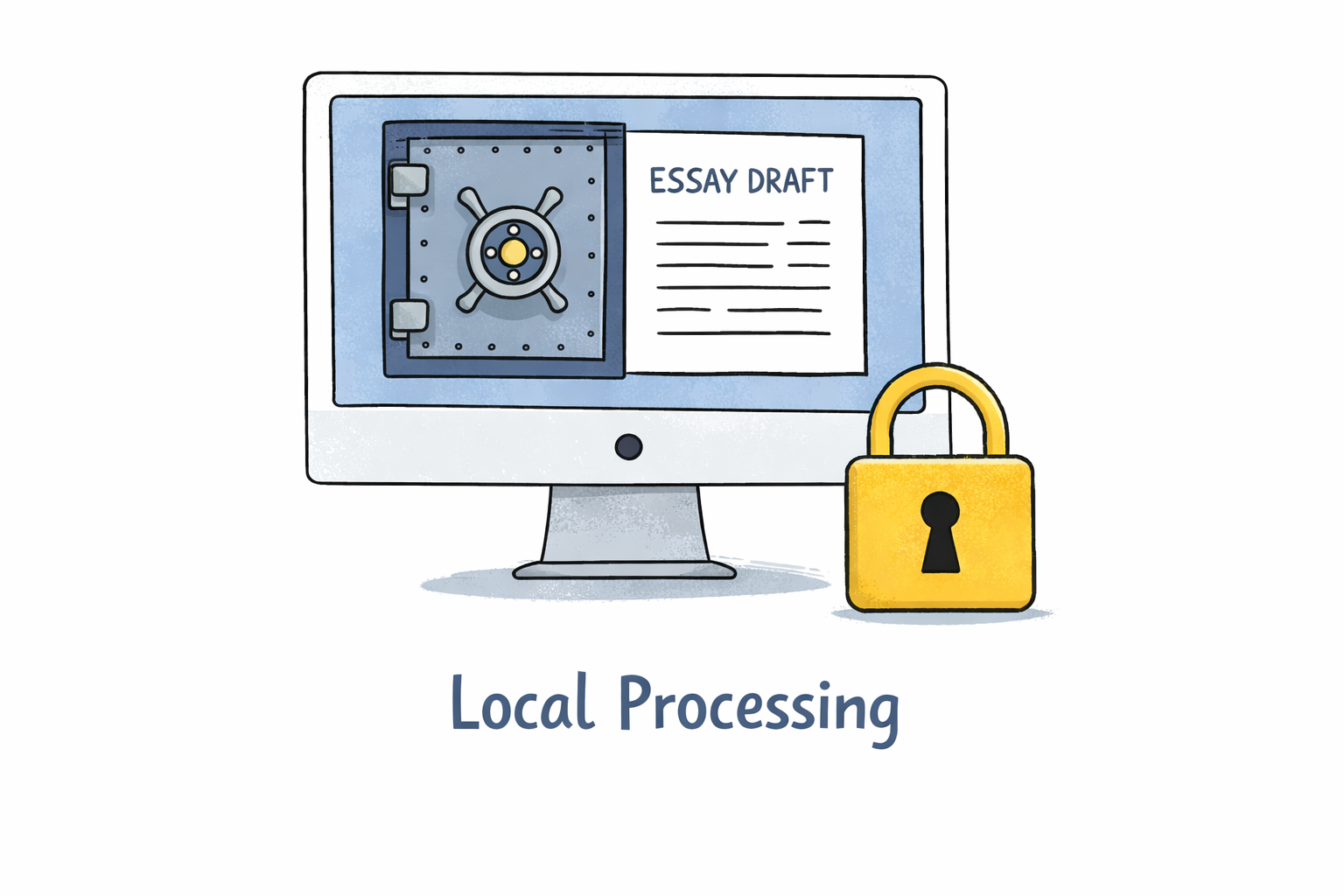
Why local processing acts as a digital vault, ensuring your sensitive academic drafts are never exposed to the cloud.
Frequently Asked Questions (FAQ)
Q: Is using Rephrazo to rewrite my essay considered cheating?
A: No, provided you use it as a revision tool and not a content generator. Cheating involves submitting unoriginal work. Using Rephrazo to improve the clarity and flow of your own ideas is a legitimate use of technology, similar to using a sophisticated grammar checker. The final intellectual content must remain your own.
Q: How does Rephrazo handle essay-length documents?
A: Rephrazo works inline, meaning it processes the text you select, whether it's a single sentence or an entire paragraph. This encourages the writer to revise iteratively, focusing on sections that need the most help, rather than submitting the entire essay for a hands-off "spin."
Q: Will my university's plagiarism checker flag the rewritten text?
A: Plagiarism checkers look for similarity to existing sources. Since Rephrazo generates unique, contextually appropriate phrasing, it is highly effective at eliminating the "patchwriting" that often triggers similarity flags. When used responsibly—to refine your own original ideas—the output is unique and should pass integrity checks.
Q: What's the difference between rewriting and paraphrasing my essay?
A: Paraphrasing focuses on restating specific sentences or passages from source material to avoid plagiarism. Rewriting involves a comprehensive overhaul of style, tone, and structure across entire paragraphs or sections. When you ask to "rewrite my essay," you're seeking structural improvement, not just sentence-level changes.
Q: How can I ensure I'm using AI rewriting tools ethically?
A: Ethical use requires three key principles: (1) Use the tool to refine your own ideas, not generate new content, (2) Critically review every AI output before accepting it, and (3) Maintain intellectual ownership of your final essay. The AI should improve the delivery of your ideas, not replace your thinking. Learn more about plagiarism legality and sentence rewriting best practices.
Conclusion
Learning how to "rewrite my essay" ethically with AI tools is about more than just improving your writing—it's about maintaining academic integrity while leveraging modern technology to enhance your workflow. The key is understanding that AI tools like Rephrazo are partners in the revision process, not replacements for your critical thinking.
By using local processing tools that protect your intellectual property, maintaining active oversight of AI-generated content, and focusing on refining your own ideas rather than generating new ones, you can achieve both efficiency and integrity in your academic writing. The future of academic writing lies in the responsible integration of AI tools that respect both your privacy and your intellectual ownership.
Ready to rewrite your essay with confidence? Download Rephrazo free and experience the power of privacy-first, inline essay rewriting that works directly in your writing application. No copy-paste, no cloud uploads, just instant, secure revision at your fingertips.
Related Articles
Explore more guides on essay writing and academic integrity: