Plagiarism: Is It Illegal? The Expert Guide to Legal, Academic, and Ethical Risks
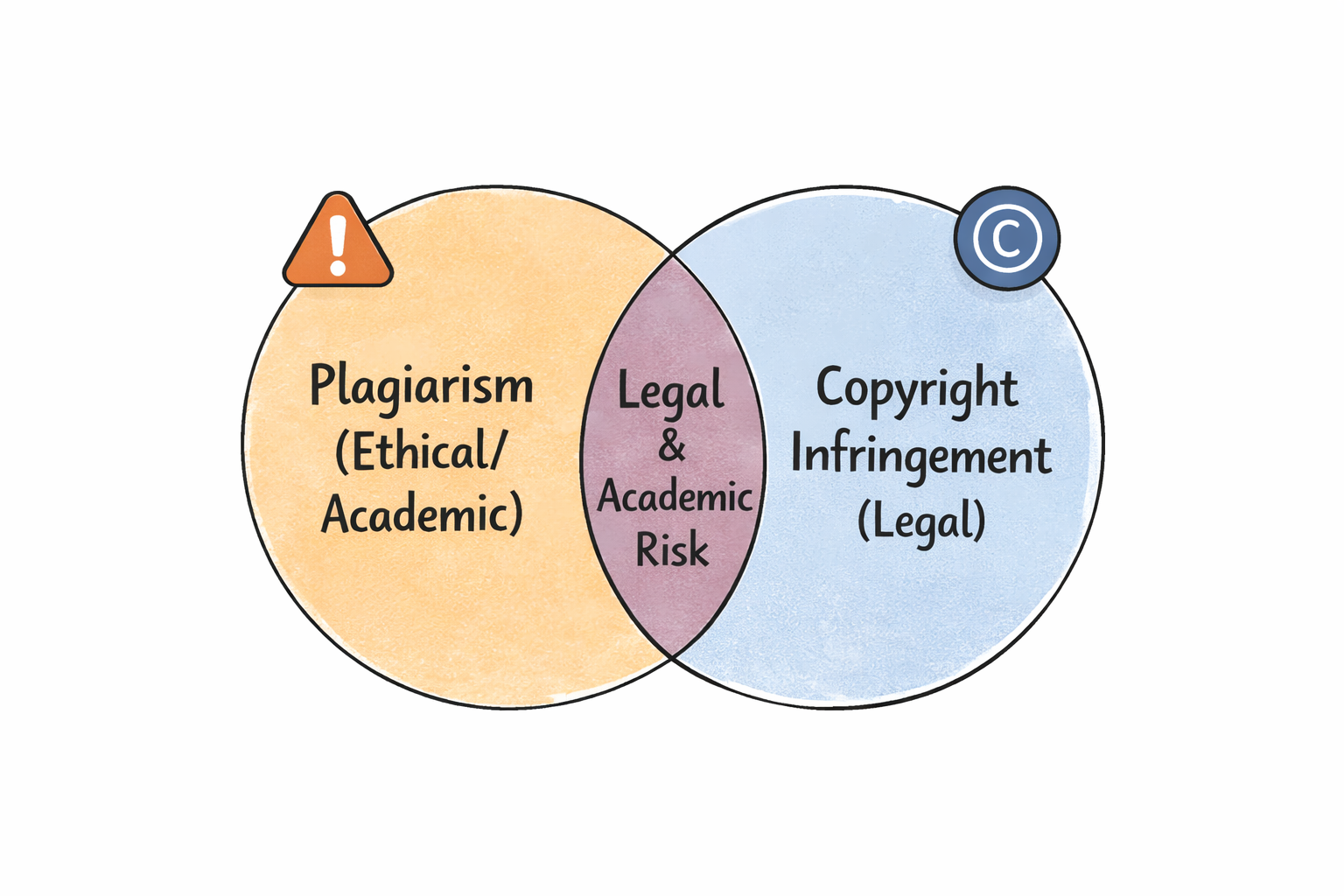
Understanding the difference between plagiarism (an ethical breach) and copyright infringement (a legal violation) is the first step to responsible writing.
Introduction
The question, "Is plagiarism illegal?" is one of the most common and critical inquiries in both academic and professional writing. It stems from a deep-seated fear: the fear of facing severe consequences for a mistake, whether intentional or accidental. The short answer is complex: Plagiarism itself is generally not a crime, but it is a severe ethical violation that can lead to legal action. This nuance is often lost, leading to widespread confusion about the true risks involved.
As an SEO content strategist focused on Expertise and Trustworthiness, our goal is to cut through the confusion. Plagiarism and the law are not interchangeable concepts. Plagiarism is an ethical breach—the failure to attribute ideas or words to their source. The law, specifically copyright law, deals with the unauthorized use of protected expression. While these two concepts often overlap, understanding their distinction is the first step toward responsible writing and protecting your reputation.
This expert guide will provide a clear, authoritative breakdown of the differences between plagiarism and copyright infringement, detail the severe consequences in academic and professional settings, and explain how modern, privacy-focused tools like Rephrazo can be used as a proactive measure to ensure both ethical and legal compliance in your writing. Learn more about how to avoid plagiarism and plagiarism legality.
The Great Confusion: Plagiarism vs. Copyright Infringement
The core of the confusion lies in the difference between an ethical code and a legal statute. Plagiarism is fundamentally an issue of ethics and attribution, while copyright infringement is an issue of property rights and law.
Plagiarism: The Ethical and Academic Violation
Plagiarism is defined as the act of taking someone else's work or ideas and passing them off as one's own. It is a violation of trust and an offense against the principles of intellectual honesty. In the academic world, plagiarism is governed by institutional honor codes and policies. The consequences are severe, ranging from a failing grade on an assignment to expulsion from the university. Crucially, you can plagiarize work that is not protected by copyright—for example, a historical fact or an idea that is in the public domain—because the offense is the failure to give credit, not the theft of property.
Copyright Infringement: The Legal Violation
Copyright infringement, conversely, is a violation of federal law. It occurs when someone uses a copyrighted work (such as a book, song, or article) without permission from the copyright holder. The purpose of copyright is to protect the expression of an idea, not the idea itself. If you copy a substantial portion of a protected text, you are infringing copyright, regardless of whether you attribute the source. This is where the overlap occurs: if you plagiarize a copyrighted work, you are committing both an ethical violation and a legal one.
| Feature | Plagiarism | Copyright Infringement |
|---|---|---|
| Definition | Using someone else's ideas/words without attribution (ethical/academic violation). | Using someone else's protected expression without permission (legal violation). |
| Governed By | Institutional honor codes, professional ethics. | Federal/International Law (e.g., U.S. Copyright Act). |
| Consequences | Failing grade, expulsion, job termination, reputational damage. | Fines, injunctions, monetary damages, criminal charges (in extreme cases). |
| Can it be illegal? | Only if it also constitutes copyright infringement. | Yes, it is a civil (and sometimes criminal) offense. |
When Plagiarism Becomes a Legal Matter
While most students will only face academic penalties, it is vital to understand the circumstances under which a writing mistake can escalate into a serious legal issue. This typically occurs in professional or commercial contexts where the plagiarized work is also protected by copyright and is used for financial gain.
The Role of Fair Use and Public Domain
Not all copying is infringement. Copyright law includes exceptions, most notably the doctrine of Fair Use, which permits limited use of copyrighted material without permission for purposes such as criticism, comment, news reporting, teaching, scholarship, or research. However, Fair Use is a complex legal defense, not a right, and relying on it requires Expertise and careful judgment. Furthermore, works in the Public Domain (e.g., works published before 1929 or those whose copyright has expired) can be plagiarized (ethically wrong) but cannot be infringed (legally permissible).
Professional Consequences: Lawsuits and Criminal Charges
In professional settings, the stakes are significantly higher. If a journalist, corporate writer, or academic researcher publishes plagiarized material that infringes on a copyright, the consequences can be immediate and devastating. The copyright holder can file a civil lawsuit seeking substantial statutory damages, which can reach up to $150,000 per infringed work if the infringement is found to be willful. In rare, extreme cases involving large-scale, for-profit piracy, criminal charges can be filed, leading to prison time. The key takeaway is that in the professional world, plagiarism is not just an ethical lapse; it is a financial and legal liability that can destroy careers and institutions.
Academic Consequences: More Than Just a Bad Grade
For students, the primary threat is academic, but the long-term impact extends far beyond a single failing grade. The Trustworthiness of your academic record is paramount, and a finding of plagiarism can permanently damage your future prospects.
The Severity Scale: From Warning to Expulsion
Academic institutions typically employ a tiered system for plagiarism offenses. A first, minor offense (often accidental, such as poor citation) might result in a warning or a required rewrite. However, severe or repeated offenses can lead to:
- A failing grade for the course.
- Suspension from the university.
- Expulsion, which is a permanent notation on your academic transcript.
An expulsion for academic dishonesty is a permanent barrier to future educational and professional opportunities. It is a penalty that follows a student for life, making it functionally as severe as many legal punishments.
The Invisible Consequence: Reputational Damage
The most insidious consequence is the damage to your reputation. In academia and professional research, reputation is currency. A finding of plagiarism can lead to retracted publications, loss of research funding, and the inability to secure letters of recommendation. This damage is often irreversible. Therefore, the focus must shift from "Will I get caught?" to "How do I ensure my work is unimpeachably original and properly attributed?"
| Setting | Primary Risk | Maximum Penalty |
|---|---|---|
| Academic | Ethical Violation | Expulsion, loss of degree, permanent record notation. |
| Professional | Reputational/Contractual | Job termination, loss of license, loss of funding. |
| Legal | Copyright Violation | Statutory damages (up to $150,000 per work), criminal prosecution. |
The Expert Solution: Prevention Through Responsible Rewriting
The best defense against both plagiarism and copyright infringement is a proactive, responsible writing process. This is where the modern AI sentence rewriter tool, when used correctly, becomes an essential part of maintaining integrity and Expertise.
Avoiding "Patchwriting" and Accidental Infringement
Accidental plagiarism often occurs through "patchwriting"—a writer's attempt to paraphrase by simply swapping a few words while retaining the original sentence structure. This is linguistically lazy and is easily flagged by plagiarism detection software. A high-quality AI tool, like Rephrazo, can generate a structurally and linguistically distinct sentence that preserves the original meaning, helping the writer break free from the source text's syntax. The tool acts as a linguistic accelerator, allowing the writer to focus on the intellectual task of ensuring proper attribution, rather than the mechanical task of finding synonyms.
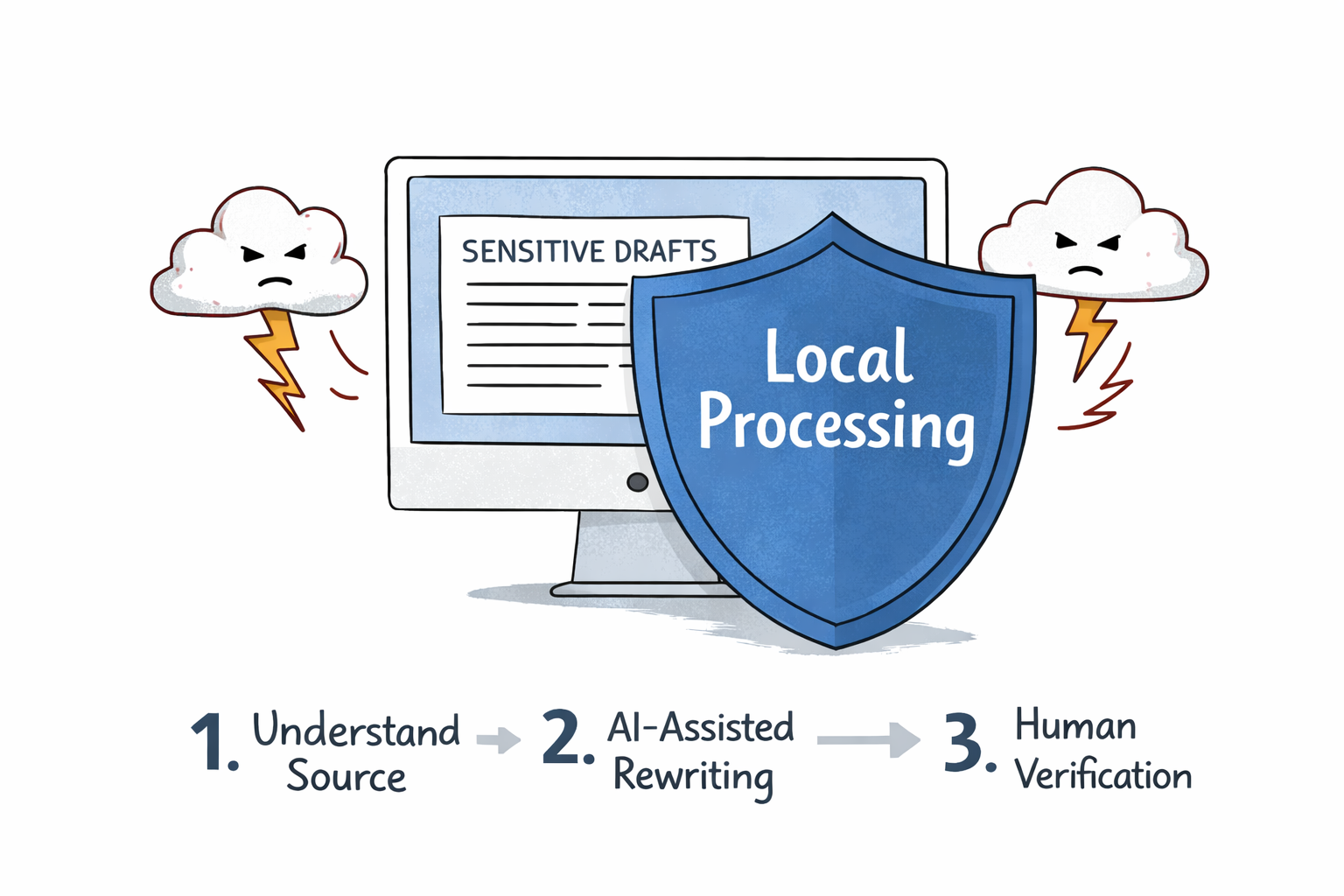
Using AI tools to ensure linguistic originality while maintaining human intellectual control and proper citation is the key to prevention.
Privacy and Prevention: Why Local Processing Matters for Integrity
The act of checking for plagiarism itself can introduce risk. Many cloud-based plagiarism checkers and AI tools require you to upload your draft to their servers, potentially exposing your work to data breaches or adding it to their proprietary databases. This is a critical Trustworthiness issue.
Rephrazo's commitment to local desktop processing eliminates this risk entirely. Your text is processed on your device, meaning your sensitive academic or professional drafts are never transmitted to the cloud. This privacy-first architecture ensures that your proactive steps to prevent plagiarism do not inadvertently create a data security risk.
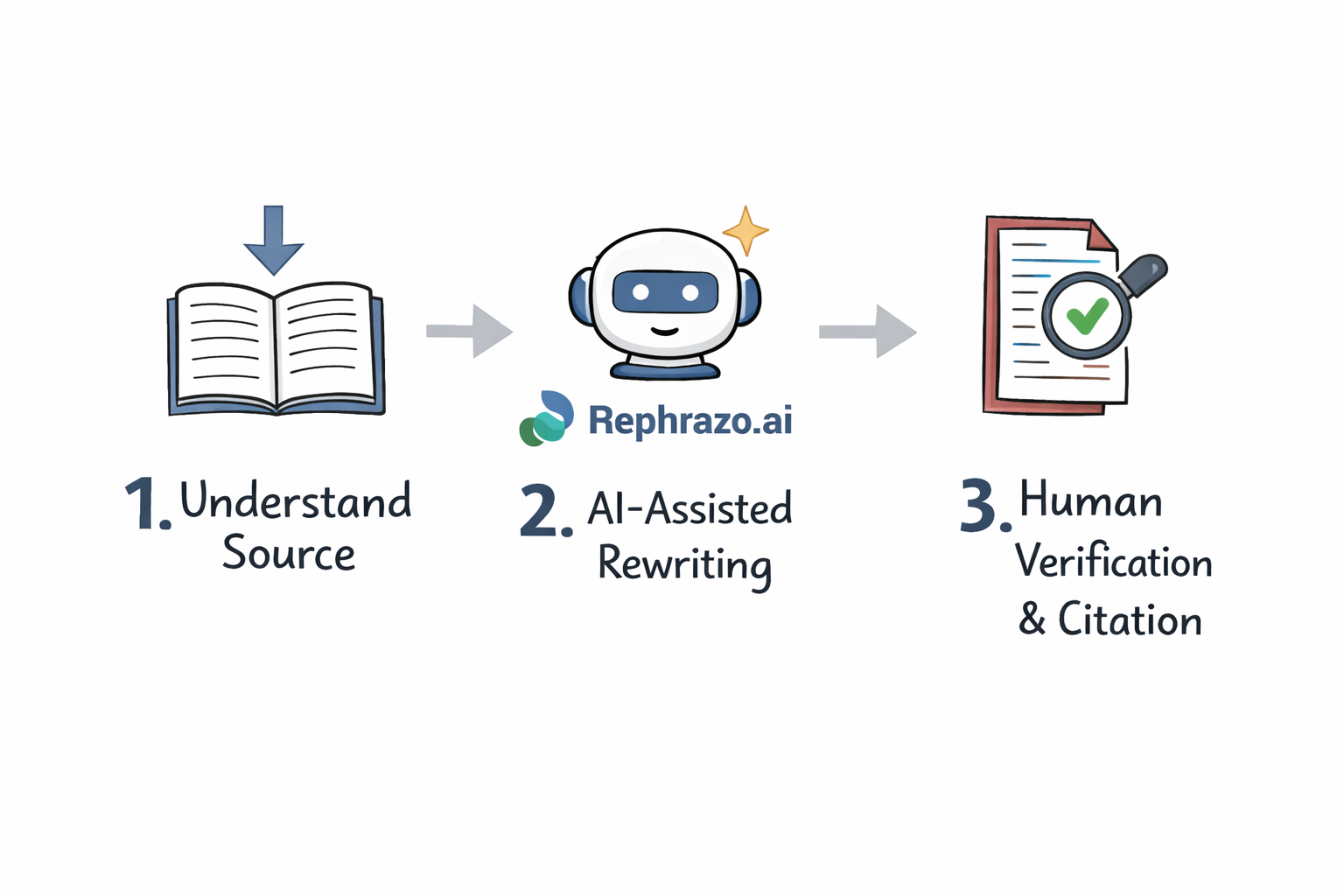
Rephrazo's local processing acts as a privacy shield, ensuring your drafts are never exposed to the cloud, eliminating a major source of data risk.
Frequently Asked Questions (FAQ)
Q: If I plagiarize a public domain work, is it illegal?
A: No. Plagiarizing a public domain work is an ethical violation because you are claiming someone else's words as your own. However, since the work is not protected by copyright, you are not committing copyright infringement, and therefore, no legal action can be taken.
Q: Does using an AI rewriter make my work less original?
A: The originality of your work lies in your ideas, research, and analysis. An AI rewriter is a tool for linguistic delivery. When used responsibly—to refine and restructure your own original thoughts—it enhances clarity and professionalism without compromising the intellectual core of your work.
Q: How can Rephrazo help me avoid accidental plagiarism?
A: Rephrazo helps you avoid the "patchwriting" trap by instantly generating structurally unique alternatives to source text, ensuring that your paraphrasing is linguistically distinct. By working inline, it encourages immediate revision and proper attribution, making the ethical workflow seamless.
Q: What's the difference between plagiarism and copyright infringement?
A: Plagiarism is an ethical violation—failing to give credit to the source of ideas or words. Copyright infringement is a legal violation—using protected expression without permission. They often overlap, but plagiarism can occur without copyright infringement (e.g., plagiarizing public domain works), and copyright infringement can occur without plagiarism (e.g., properly citing but illegally reproducing a work).
Q: Can I face legal consequences for plagiarizing in an academic paper?
A: Generally, no—academic plagiarism typically results in institutional penalties (failing grades, expulsion). However, if your plagiarized work also constitutes copyright infringement (e.g., copying substantial portions of a copyrighted source) and is published or used commercially, you could face legal action. The key is understanding when plagiarism crosses into copyright infringement territory.
Conclusion
The question "Is plagiarism illegal?" reveals a fundamental misunderstanding about the relationship between ethics and law. While plagiarism itself is typically not a criminal offense, it is a serious ethical violation that can have devastating academic and professional consequences. When plagiarism overlaps with copyright infringement, the stakes become even higher, potentially leading to substantial financial penalties and legal action.
The expert approach is not to focus on avoiding detection, but to build a writing process that ensures originality and proper attribution from the start. Tools like Rephrazo, with their local processing and inline workflow, provide the speed and privacy needed to maintain integrity while working efficiently. By understanding the distinction between plagiarism and copyright infringement, and by using responsible rewriting practices, you can protect both your reputation and your legal standing.
Ready to write with integrity and confidence? Download Rephrazo free and experience the power of privacy-first, inline rewriting that helps you avoid both plagiarism and copyright infringement. Learn more about sentence rewriting best practices and ethical essay rewriting.
Related Articles
Explore more guides on plagiarism prevention and academic writing: