Introduction: Mastering the Different Ways to Write
Writing is not a monolithic skill. It is a dynamic, multifaceted craft that adapts to its audience, purpose, and context. The profound ability to navigate these different ways to write is what separates a merely competent writer from a true, distinguished master of the craft. Whether you are a dedicated student striving for academic clarity, a seasoned professional aiming for maximum persuasive impact, or a creative spirit meticulously weaving a compelling narrative, a deep understanding of the intricate nuances of writing styles is absolutely paramount to your ultimate success and influence.
Many writers, however, find themselves confined to a single, comfortable "voice." They may excel at writing descriptive prose but struggle to construct a concise, data-driven report. This limitation can hinder academic performance, stall professional growth, and stifle creative expression. The modern writer must be a chameleon, capable of shifting their tone, structure, and vocabulary at a moment's notice.
This guide, grounded in the principles of E-E-A-T (Experience, Expertise, Authoritativeness, and Trustworthiness), will serve as your comprehensive roadmap to mastering the different ways to write. We will meticulously explore the core writing styles, dissect the innovative methods of modern composition, and reveal precisely how to adapt your voice with unparalleled precision. By the end of this masterclass, you will not only understand the underlying theory but also possess the practical knowledge to confidently leverage cutting-edge modern tools, like Rephrazo, to become an exceptionally versatile and highly effective writer in any domain.

The Spectrum of Writing Methods. Visualizing the diverse styles and methods of modern written communication.
The Four Pillars of Writing: Exploring Core Styles
At its heart, all writing can be categorized into four primary styles. Recognizing which style to use is the first step toward effective communication. An expert writer doesn't just have a strong command of language; they have an intuitive sense of which stylistic vehicle will best carry their message to its destination.
1. Expository Writing: The Art of Explanation
Expository writing is the backbone of academic and professional communication. Its sole purpose is to inform, explain, or describe a topic with clarity and objectivity. Think of textbooks, news articles, and technical manuals. The E-E-A-T focus here is on Expertise and Authoritativeness. Your goal is to present facts and evidence in a logical, structured manner, leaving no room for ambiguity.
"Expository writing is the most common type of nonfiction. It's a subject-oriented writing style, in which authors focus on telling you about a given topic or subject without voicing their personal opinions."
2. Descriptive Writing: Painting with Words
Where expository writing tells, descriptive writing shows. This style is dedicated to creating a vivid, sensory experience for the reader. It is the language of poetry, creative fiction, and evocative marketing copy. Here, the writer's Experience is key. You must draw upon your own observations and emotions to paint a picture that resonates with the reader on a deeper level.
3. Persuasive Writing: The Craft of Influence
Persuasive writing aims to convince the reader to adopt a particular viewpoint or take a specific action. This is the style of opinion essays, marketing campaigns, and legal arguments. Trustworthiness is the cornerstone of effective persuasion. Your arguments must be built on a foundation of sound logic and credible evidence, presented with a confident and authoritative tone.
4. Narrative Writing: The Power of Story
Narrative writing is the art of telling a story. Whether it's a personal anecdote, a fictional short story, or a historical account, narrative writing engages the reader on an emotional level. It follows a clear arc, with a beginning, middle, and end, and often features compelling characters and a central conflict. This style allows the writer to share their Experience in a way that is both personal and universal. For more on structuring academic stories, see our essay rewriting guide.
The Modern Scribe: Different Methods of Writing
The "how" of writing has evolved just as much as the "what." The tools we use to compose our thoughts have a profound impact on our creative process, from the deliberate pace of longhand to the instantaneous feedback of AI.
Traditional Methods: The Pen vs. The Keyboard
There is a growing body of research suggesting that writing by hand can enhance cognitive engagement and memory retention. The slower pace of longhand encourages more deliberate thought and can lead to more creative and well-structured sentences. Typing, on the other hand, offers unparalleled speed and ease of revision, making it the default for most professional and academic tasks.

Traditional vs. Modern Writing Methods. Comparing the cognitive engagement of longhand with the efficiency of digital composition.
Collaborative Writing: The Power of Many
In today's interconnected world, writing is often a team sport. Tools like Google Docs, Microsoft Word's co-authoring features, and even Slack have transformed writing into a real-time, collaborative process. This method requires a different skill set, one that emphasizes clear communication, shared ownership, and the ability to integrate feedback constructively.
AI-Assisted Writing: The New Frontier
AI-powered writing assistants represent the most significant evolution in writing technology since the word processor. These tools can help with everything from grammar and spelling to tone adjustment and style transformation. However, their use also raises important ethical questions about originality and authorship, making Trustworthiness a critical factor in their adoption. Learn how to use AI rewrite tools ethically for academic work.
| Method | Speed | Focus & Retention | Creativity | Ease of Revision |
|---|---|---|---|---|
| Longhand | Slow | High | High | Very Low |
| Typing | Fast | Medium | Medium | High |
| Collaborative | Variable | Medium | Variable | High |
| AI-Assisted | Instant | Low (if misused) | High (for ideation) | Instant |
Adapting Your Tone: The Art of the Vocal Shift
Mastering different writing styles is only half the battle. The true expert can also modulate their tone to suit any situation. Tone is the attitude you convey toward your subject and your audience. It's the subtle difference between a formal academic paper and a friendly blog post, even if the subject matter is the same.
Formal vs. Informal: Navigating the Contextual Divide
Formal writing is characterized by complex sentences, a sophisticated vocabulary, and an objective, third-person perspective. It is the standard for academic research and professional reports. Informal writing, in contrast, uses simpler language, a more conversational tone, and often a first-person perspective. Knowing when to switch between these two is a hallmark of a versatile writer. Our guide on writing more concisely helps refine both styles.
Active vs. Passive Voice: A Question of Authority
The active voice ("The scientist conducted the experiment") is generally preferred for its clarity and directness. It conveys a sense of authority and confidence. The passive voice ("The experiment was conducted by the scientist"), while grammatically correct, can often sound evasive or overly academic. An experienced writer knows how to use both to strategic effect.
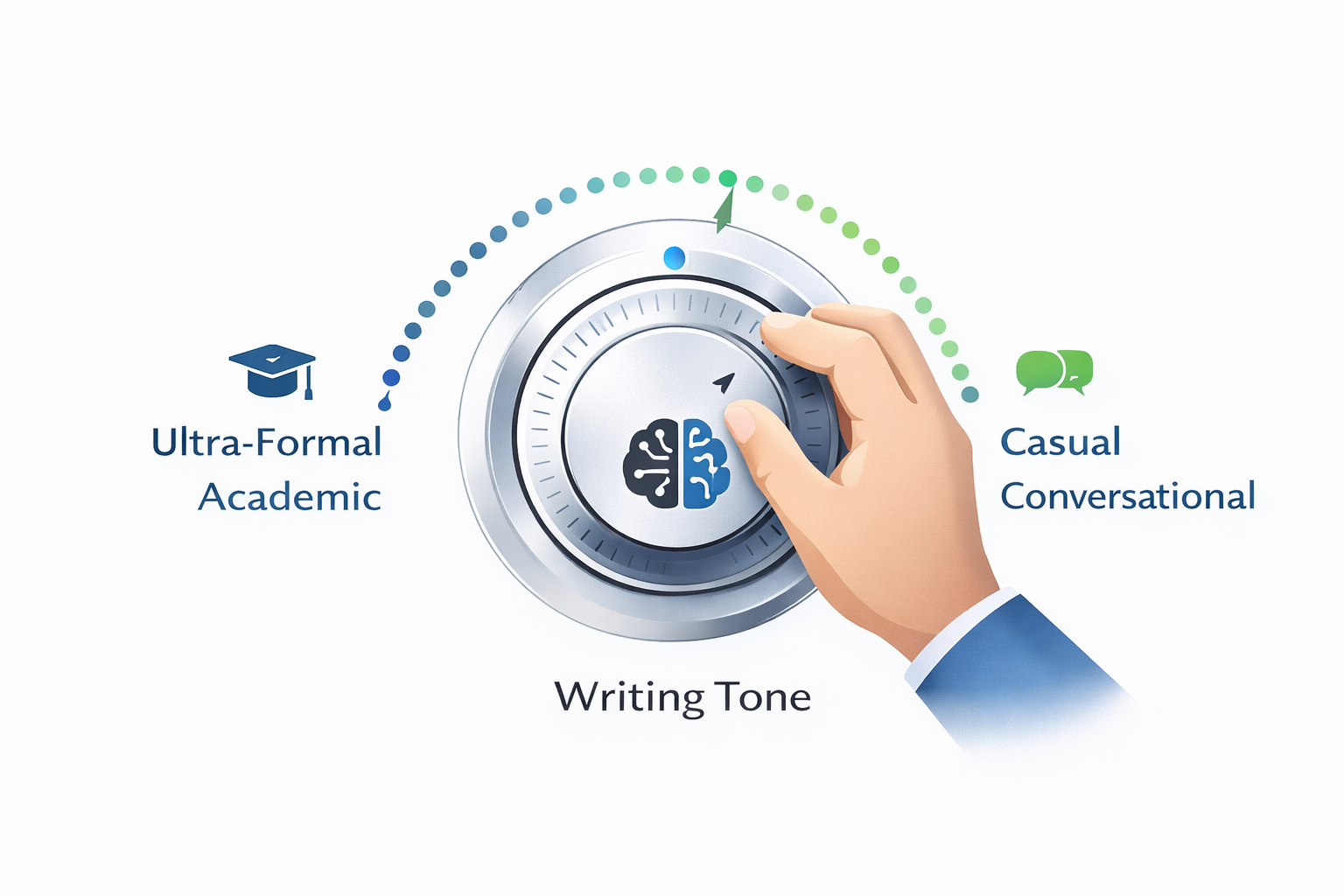
The Tone Modulation Dial. Modulating tone and voice to suit different academic and professional contexts.
Common Challenges in Mastering Different Writing Styles
Tone Inconsistency: The "Clashing Voices" Problem
One of the most common mistakes is a failure to maintain a consistent tone throughout a piece of writing. This often happens when a writer tries to switch styles mid-stream without a clear plan, resulting in a jarring and unprofessional final product.
Writer's Block: The Blank Page Conundrum
Staring at a blank page can be intimidating. Sometimes, the best way to overcome writer's block is to simply start writing in a different style. If you're struggling with a formal report, try writing a narrative version of the same information to get your creative juices flowing.
The Role of Technology in Modern Writing: An E-E-A-T Perspective
Efficiency and the Ethical Use of AI
AI tools can dramatically increase the efficiency of the writing process, but they must be used as a supplement to, not a substitute for, human expertise. Using an AI to help you rephrase a sentence for clarity is an example of responsible use. Using it to generate an entire essay from a single prompt is a violation of academic and professional integrity. See our guide on how to not plagiarize for best practices.
Privacy: Protecting Your Unique Voice
As with any cloud-based technology, privacy is a major concern. When you use an online writing tool, you are often entrusting your unique ideas and writing style to a third-party company. This is why privacy-first, desktop-based tools are becoming increasingly important for writers who value their intellectual property.
Rephrazo: Your Partner in Stylistic Mastery
This is where a tool like Rephrazo, designed with the expert writer in mind, becomes an invaluable asset. It is not a "content generator" but a sophisticated instrument for refining and adapting your own original thoughts.
Instant Style Transformation
Imagine you've just finished a highly technical academic paragraph, and you need to share the key findings with a non-expert audience in a Slack message. With a tool like Rephrazo, you can instantly transform that dense, formal prose into a clear, concise, and informal summary. This ability to modulate your style on the fly is a superpower for the modern writer.
Inline Mastery Across All Your Apps
The true power of Rephrazo lies in its seamless, inline integration. It works directly within Word, Outlook, Slack, and any other application on your desktop. There is no need to break your creative flow by copying and pasting text into a browser window. This keeps you in the "zone," allowing you to focus on your ideas rather than the mechanics of the tool. Compare with our QuillBot alternative page for more options.
A Commitment to Privacy
Unlike its cloud-based competitors, Rephrazo processes all of your text locally on your machine. Your writing, your style, and your ideas remain your own. This commitment to privacy is a cornerstone of the tool's E-E-A-T philosophy, ensuring that you can write with confidence and peace of mind.
Ready to master every different way to write? Download Rephrazo free and transform your style across academic, professional, and creative contexts—with speed, precision, and absolute privacy.
Frequently Asked Questions
Q: What is the most effective way to write an academic paper?
A: Effective academic writing combines an expository style (to present facts) with a persuasive style (to argue a thesis). It demands a formal tone, a logical structure, and a deep respect for the principles of academic integrity. For step-by-step guidance, see our essay rewriter academic guide.
Q: How can I change my writing style without losing my authentic voice?
A: Your authentic voice is a reflection of your unique perspective, not just your sentence structure. Use AI tools as a "suggestion engine" to explore different ways to write and phrase your ideas. Read the suggestions aloud and choose the ones that still sound like you.
Q: Are AI tools helpful for creative writing?
A: Absolutely. AI can be a powerful brainstorming partner for creative writers. Use it to generate story prompts, explore different character voices, or find new ways to describe a scene. The key is to use it as a spark for your own creativity, not a replacement for it.
Q: How does Rephrazo handle different writing contexts?
A: Rephrazo is context-aware, meaning it analyzes the surrounding text to suggest rewrites that fit the specific style and tone of your document, whether it's a formal report in Word or a casual update in Slack.
Q: What are the main different ways to write?
A: The four main writing styles are expository (inform and explain), descriptive (paint with words), persuasive (convince and influence), and narrative (tell a story). Methods include longhand, typing, collaborative writing, and AI-assisted writing—each with different strengths for speed, creativity, and revision.