Introduction
In the dynamic world of Search Engine Optimization (SEO), content is not a static asset; it's a living entity that requires constant care and attention. Old content can decay in rankings, lose relevance, and ultimately fail to drive traffic. The solution? Strategic content refreshing and repurposing. However, this process is fraught with challenges, from avoiding duplicate content penalties to ensuring the refreshed content maintains high quality and E-E-A-T (Experience, Expertise, Authoritativeness, and Trustworthiness) signals. This is where the right SEO tools article rewriter becomes indispensable.
As an SEO content strategist focused on delivering tangible results, our goal is to provide a professional guide to leveraging article rewriters for maximum SEO impact. This article will delve into the technical nuances of structural rewriting, explore how to refresh content at scale without compromising quality, and highlight the critical importance of data privacy for agencies and businesses handling sensitive client information. We believe that an effective SEO article rewriter should empower content managers to revitalize their assets, not merely rephrase them.
This expert guide will explore the evolution of article rewriting in the age of Google's Helpful Content Update, compare different approaches to content transformation, and demonstrate how a privacy-first AI solution like Rephrazo can serve as the ultimate content refresh utility, helping you maintain top rankings and build unwavering client trust.
The Evolution of Article Rewriting in the Era of Helpful Content
The concept of article rewriting has come a long way from its early, often maligned, origins. What began as rudimentary "article spinning"—a practice designed to generate multiple versions of an article by simply swapping synonyms—has evolved into a sophisticated process of structural and semantic transformation. This evolution has been largely driven by Google's continuous efforts to reward high-quality, helpful content.
From "Spinning" to Structural Transformation: A Technical Overview
Early article spinners were notorious for producing unreadable, grammatically awkward content that offered little to no value to the reader. Their methodology was purely lexical, focusing on word-level substitutions. Modern SEO, however, demands a deeper, more intelligent approach:
- Syntactic Variation: Changing sentence structures (e.g., active to passive voice, combining or splitting sentences) to create genuinely new phrasing.
- Semantic Richness: Ensuring that the rewritten content maintains or enhances the original meaning, adding context, examples, or fresh perspectives where appropriate.
- Paragraph Restructuring: Reorganizing the flow of ideas within and between paragraphs to improve coherence and readability.
- Tone and Style Adjustment: Adapting the writing style to better suit the target audience or brand voice, moving beyond generic AI output.
This shift from superficial spinning to structural transformation is critical for any SEO tools article rewriter aiming to deliver real value.
Why Google's Helpful Content Update Rewards Quality Rewriting
Google's "Helpful Content Update" and its emphasis on E-E-A-T have fundamentally changed how content is evaluated. The update explicitly targets content that is primarily created for search engines rather than humans. This means that content that merely rehashes existing information without adding value, or that sounds generic and unoriginal, is unlikely to rank well. Quality rewriting, however, aligns perfectly with Google's goals:
- Adds Freshness: By updating old content with new insights, data, and phrasing, you signal to Google that the content is current and relevant.
- Enhances User Experience: Well-written, clear, and engaging content keeps users on the page longer, reducing bounce rates and improving engagement metrics.
- Strengthens E-E-A-T: Structural rewriting allows for the integration of new expert opinions, unique experiences, and authoritative sources, bolstering the content's credibility.
- Avoids Perceived Duplication: By creating genuinely unique versions of content, you mitigate the risk of Google perceiving your content as unoriginal or low-value.
Therefore, an SEO tools article rewriter that facilitates structural transformation is not just a convenience; it's a strategic necessity for maintaining and improving search rankings.
| Feature | Word Spinning (Legacy Approach) | Structural Rewriting (Modern SEO Approach) |
|---|---|---|
| Methodology | Lexical replacement (synonym swapping). | Syntactic and semantic transformation. |
| SEO Impact | High risk of being flagged as low-quality or spammy. | Signals a significant content update, improving freshness scores. |
| Duplicate Content Risk | High; sentence structure remains too similar. | Low; creates genuinely unique content with the same core message. |
| E-E-A-T Signals | Weakens E-E-A-T by introducing awkward phrasing and diluting expertise. | Strengthens E-E-A-T by improving clarity, readability, and user experience. |
| Use Case | Obsolete for modern SEO. | Content refreshing, repurposing, and quality improvement. |
Content Refreshing at Scale: Why Structural Rewriting is the New Standard
For large websites, e-commerce platforms, or agencies managing extensive content portfolios, the task of content refreshing can be monumental. Manually updating hundreds or thousands of articles is time-consuming and resource-intensive. This is where an efficient SEO tools article rewriter becomes a game-changer, enabling content managers to refresh content at scale while adhering to the highest standards of quality and E-E-A-T. This process is a testament to the Experience of a well-managed content strategy.
The Technical SEO Benefits of High-Quality Content Refreshes
Regular, high-quality content refreshes offer several significant SEO advantages:
- Improved Rankings: Google favors fresh, up-to-date content, especially for evergreen topics. Refreshes can boost rankings for existing pages.
- Increased Organic Traffic: Higher rankings lead to more visibility and clicks, driving organic traffic.
- Enhanced User Engagement: Updated content is more relevant and valuable to users, leading to lower bounce rates and longer time on page.
- Expanded Keyword Reach: Refreshes allow for the integration of new long-tail keywords and semantic variations, broadening the content's search footprint.
- Reduced Content Cannibalization: By ensuring each piece of content is distinct and serves a unique user intent, refreshes help prevent different pages from competing for the same keywords.
Structural rewriting is the engine that drives these benefits, transforming outdated content into valuable, ranking assets.
Avoiding the "AI Voice" to Maintain E-E-A-T Signals
While AI can assist in content refreshing, the challenge lies in avoiding the generic "AI voice" that can dilute E-E-A-T signals. Content that sounds bland, repetitive, or lacks a distinct perspective will struggle to establish Expertise and Authoritativeness. A sophisticated SEO tools article rewriter, like Rephrazo, helps overcome this by:
- Facilitating Human Oversight: Providing intelligent suggestions that a human editor can review, select, and further refine.
- Promoting Unique Phrasing: Offering diverse structural alternatives that move beyond simple synonym swaps, ensuring the refreshed content sounds natural and original.
- Injecting Brand Voice: Allowing content teams to maintain a consistent brand tone and style across all refreshed assets.
The goal is to leverage AI for efficiency while preserving the human touch that builds trust and credibility with both readers and search engines.
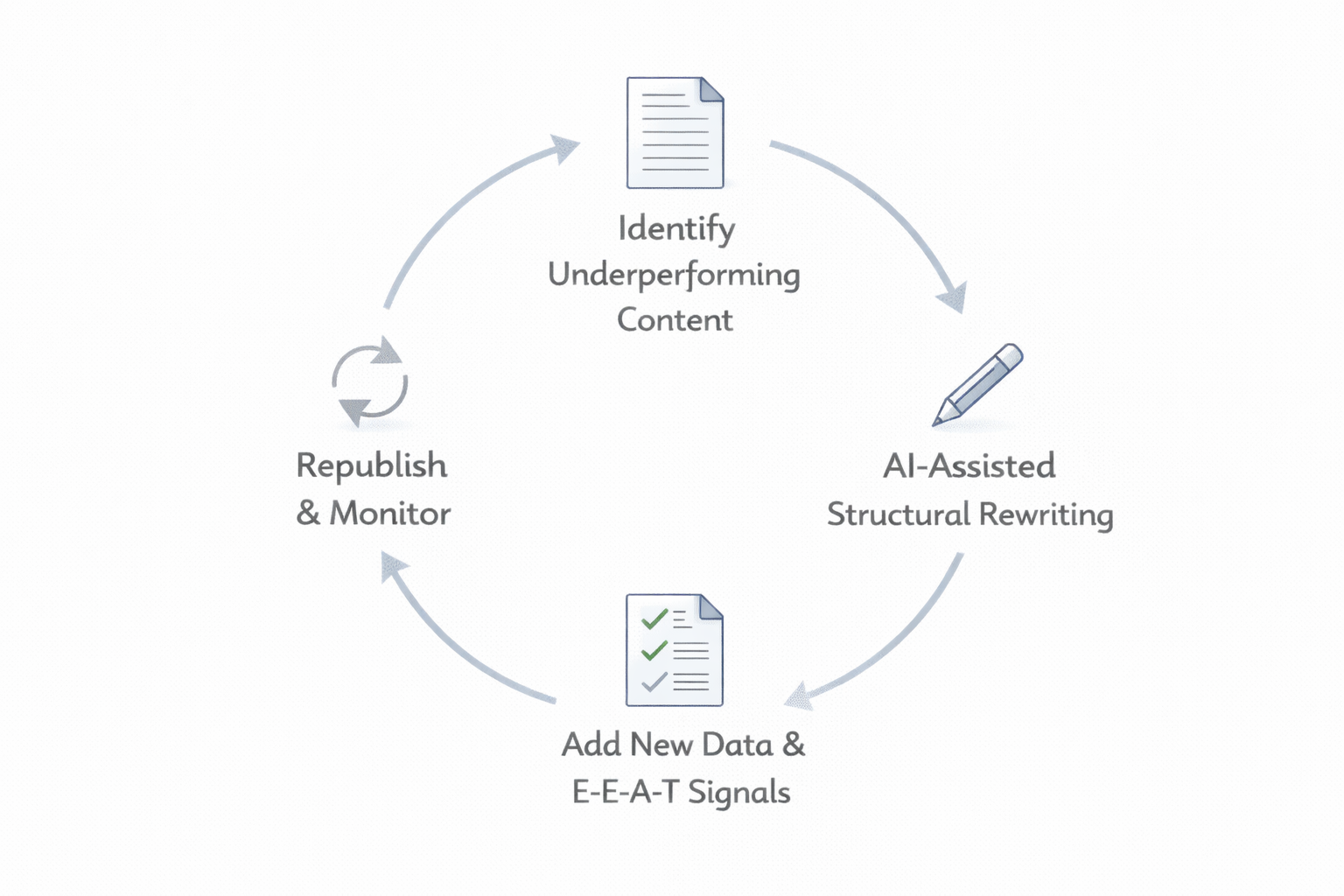
The Content Refresh Cycle. A systematic approach to revitalizing existing content, using AI-assisted structural rewriting to boost freshness, relevance, and E-E-A-T signals.
Beyond Duplicate Content: Repurposing Your Assets for Maximum ROI
Content repurposing is a powerful strategy for maximizing the return on investment (ROI) of your existing content assets. Instead of creating entirely new content for every platform, you can transform a single long-form article into multiple, distinct pieces suitable for different channels. The key to successful repurposing, especially for SEO, is to ensure that each new piece is semantically unique, avoiding any potential duplicate content issues. This requires Expertise in linguistic transformation.
Creating Semantically Unique Content from a Single Source
The challenge with repurposing is to create variations that are distinct enough to be considered unique by search engines, yet retain the core message and value of the original. A high-quality SEO tools article rewriter facilitates this by:
- Generating Diverse Structural Variations: Transforming sentences and paragraphs into entirely new constructions, rather than just swapping words.
- Adjusting for Platform-Specific Tone: Rewriting sections to fit the conversational style of social media, the concise nature of email newsletters, or the directness of landing page copy.
- Focusing on Different Angles: Highlighting specific aspects of the original content that are most relevant to a particular repurposed asset.
This approach allows you to extract maximum value from your content investments without risking SEO penalties.
The Workflow: From Long-Form Article to Social Posts and Newsletters
Imagine taking a comprehensive blog post and, with the help of an advanced article rewriter, transforming it into:
- Multiple Social Media Updates: Short, punchy snippets tailored for Twitter, LinkedIn, or Facebook.
- An Engaging Email Newsletter: A concise summary with a strong call to action, driving traffic back to the original article.
- Key Takeaways for a Presentation: Bullet points and simplified explanations for a slide deck.
- FAQs for a Product Page: Direct answers derived from the article's content.
Rephrazo's inline rewriting capabilities make this workflow seamless, allowing content teams to quickly adapt and distribute their message across all relevant channels, enhancing their overall Experience and reach. Learn more about rewriting without copy-paste and discover how to streamline your content workflow.
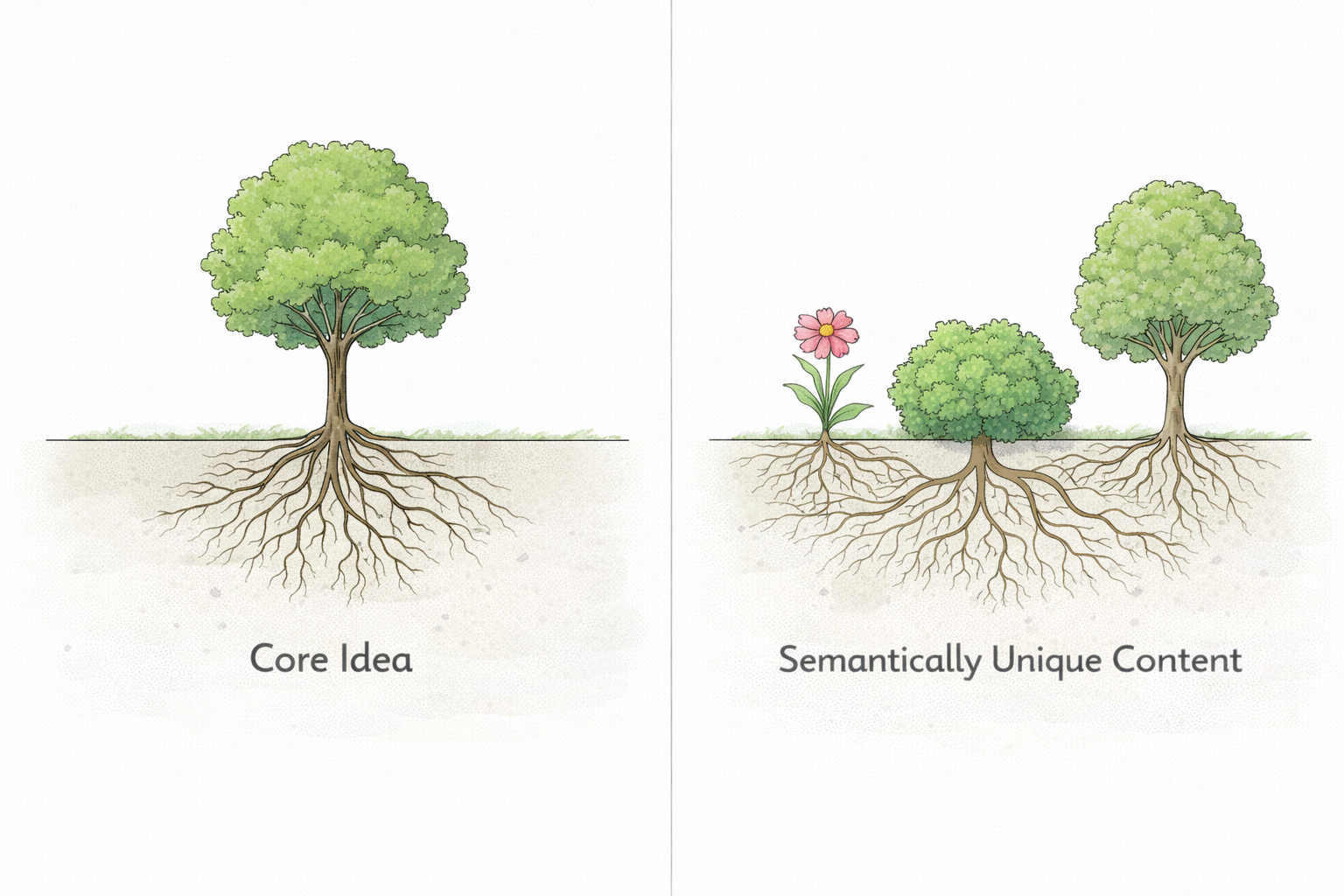
Achieving Semantic Uniqueness. The goal of modern article rewriting is not to spin content, but to create genuinely distinct, valuable assets from a single core idea, maximizing ROI without duplication.
Data Sovereignty for SEO Agencies: Why Local Processing Wins
For SEO agencies, managing client content involves a high degree of Trustworthiness. Client strategies, proprietary product information, and unpublished content are highly sensitive assets. The choice of an SEO tools article rewriter, therefore, is not just about efficiency; it's about safeguarding intellectual property and maintaining client confidentiality. This is where the architectural design of the tool—specifically, its approach to data processing—becomes paramount.
The Unacceptable Risks of Cloud-Based Rewriters for Client Data
Many popular AI-powered article rewriters operate as cloud-based services. This means that when an agency uses them, client content is uploaded to external servers for processing. This practice introduces several unacceptable risks:
- Data Breaches: Client strategies, product launches, or confidential market research could be exposed if the cloud provider experiences a security incident.
- NDA Violations: Uploading client data to third-party servers can directly violate non-disclosure agreements, leading to severe legal and reputational consequences.
- Intellectual Property Leakage: Unpublished content or unique selling propositions could inadvertently be used to train AI models, compromising their originality and competitive advantage.
- Compliance Headaches: Navigating data protection regulations (GDPR, CCPA, etc.) becomes significantly more complex when client data is processed and stored by multiple third parties across different jurisdictions.
For agencies, the perceived convenience of cloud-based tools simply does not outweigh these profound risks.
Local Processing: The Gold Standard for Agency Security and Client Trust
Rephrazo is built on a foundation of privacy-first design, utilizing local desktop processing. This means that all client content—from initial briefs to final drafts—is processed entirely on the agency's own computers. Your data never leaves your devices, never touches external servers, and is never used for AI model training. This commitment to local processing establishes Rephrazo as the gold standard for agency security and reinforces client Trustworthiness:
- Complete Data Sovereignty: Agencies retain absolute control over all client content, ensuring it remains within their secure environment.
- Zero Cloud Transmission: Eliminates the risk of data interception or exposure during transit to external servers.
- Simplified NDA Compliance: Makes it straightforward to adhere to strict client confidentiality agreements.
- Enhanced Client Trust: Demonstrates a proactive and tangible commitment to safeguarding their intellectual property and confidential information, a key differentiator in a competitive market.
With Rephrazo, SEO agencies can leverage the power of AI for content refreshing and repurposing, confident that their most valuable assets—their clients' trust and data—are absolutely secure.
| Feature | Cloud-Based SEO Rewriters | Rephrazo (Local Processing) |
|---|---|---|
| Data Transmission | Client content strategies and drafts sent to external servers. | All data remains on the agency's local machines, behind their firewall. |
| Data Storage | Stored on third-party infrastructure, often in unknown jurisdictions. | Never stored externally, ensuring full data sovereignty. |
| Confidentiality Risk | High; potential for leaks of embargoed content or client IP. | Extremely Low; data is protected by local security protocols. |
| NDA Compliance | Complicates compliance with client non-disclosure agreements. | Simplifies NDA compliance and builds unbreakable client trust. |
| Competitive Advantage | A potential liability if a breach occurs. | A strong selling point for agencies prioritizing client data security. |
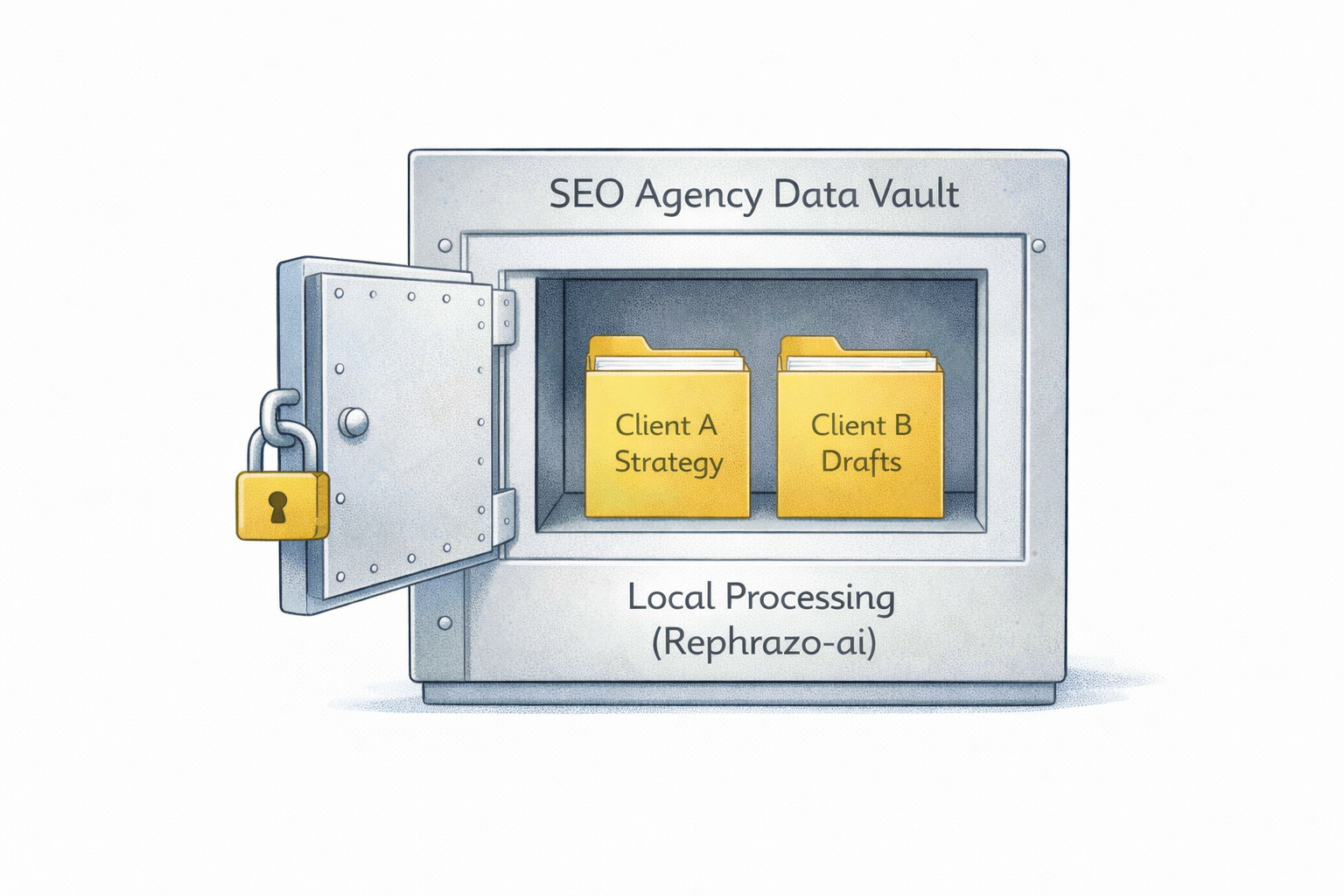
The SEO Agency Data Vault. Rephrazo's local processing ensures that sensitive client strategies and unpublished content remain completely confidential, making it the gold standard for agency security.
Frequently Asked Questions (FAQ)
Q: How does Rephrazo differ from other SEO article rewriters?
A: Unlike many rewriters that perform superficial word-swapping, Rephrazo focuses on structural and semantic transformation. This means it helps you create genuinely unique versions of content, crucial for avoiding duplicate content issues and enhancing E-E-A-T. Crucially, its local processing ensures your client data remains confidential.
Q: Can Rephrazo help me refresh hundreds of articles efficiently?
A: Absolutely. Rephrazo's inline rewriting capabilities and hotkey integration allow for rapid, context-aware content transformation directly within your CMS or document editor. This eliminates the inefficient copy-paste loop, enabling content managers to refresh and repurpose content at scale with unprecedented speed and quality.
Q: Is using an article rewriter ethical for SEO?
A: Yes, when used responsibly. The key is to use tools like Rephrazo to enhance and refine human-driven content, not to generate spam. By focusing on structural rewriting, improving readability, and adding value, you align with Google's Helpful Content guidelines, ensuring your refreshed content is both SEO-friendly and genuinely useful to readers.
Q: How does Rephrazo protect client data for SEO agencies?
A: Rephrazo uses local desktop processing, meaning all content is processed on your computer and never sent to external servers. This ensures complete data sovereignty, simplifies NDA compliance, and builds unbreakable client trust. Your sensitive client strategies and unpublished content remain secure and confidential at all times.
Conclusion
The demands of modern SEO require tools that go beyond basic rephrasing. Strategic content refreshing and repurposing are essential for maintaining rankings, maximizing ROI, and building E-E-A-T signals. An effective SEO tools article rewriter like Rephrazo enables you to transform outdated content into valuable, ranking assets while protecting your most sensitive data.
By focusing on structural rewriting rather than superficial word-spinning, you can refresh content at scale, create semantically unique variations for repurposing, and maintain the highest standards of quality and trustworthiness. Most importantly, choosing a tool with local processing ensures that your client data remains secure and confidential, building unwavering trust in an increasingly competitive market.
Ready to transform your content strategy? Download Rephrazo free and experience the ultimate SEO article rewriter for content refreshing and repurposing. Stop letting your content decay. Start revitalizing with intelligence and integrity. Explore more SEO content writing tools and learn how to rewrite articles for SEO effectively.